

Volume 36, Issue 264 (11-2026)
J Mazandaran Univ Med Sci 2026, 36(264): 249-259 |
Back to browse issues page



Download citation:
BibTeX | RIS | EndNote | Medlars | ProCite | Reference Manager | RefWorks
Send citation to:


BibTeX | RIS | EndNote | Medlars | ProCite | Reference Manager | RefWorks
Send citation to:
Nasiri Formi E, Tabatabaei Aghda S J, Tabatabaei Aghda S A T A, Khan N. The Effects of Arnebia euchroma Extract on Wound Healing: A Systematic Review and Meta-Analysis of Animal Studies. , J Mazandaran Univ Med Sci. 2026; 36 (264) :249-259
URL: http://jmums.mazums.ac.ir/article-1-22881-en.html
URL: http://jmums.mazums.ac.ir/article-1-22881-en.html
Ebrahim Nasiri Formi 
 , Seyyed Jamaleddin Tabatabaei Aghda , Seyyed Abolfazl Tabatabaei Aghda3 Tabatabaei Aghda * , Naushad Khan
Abstract: (22 Views)
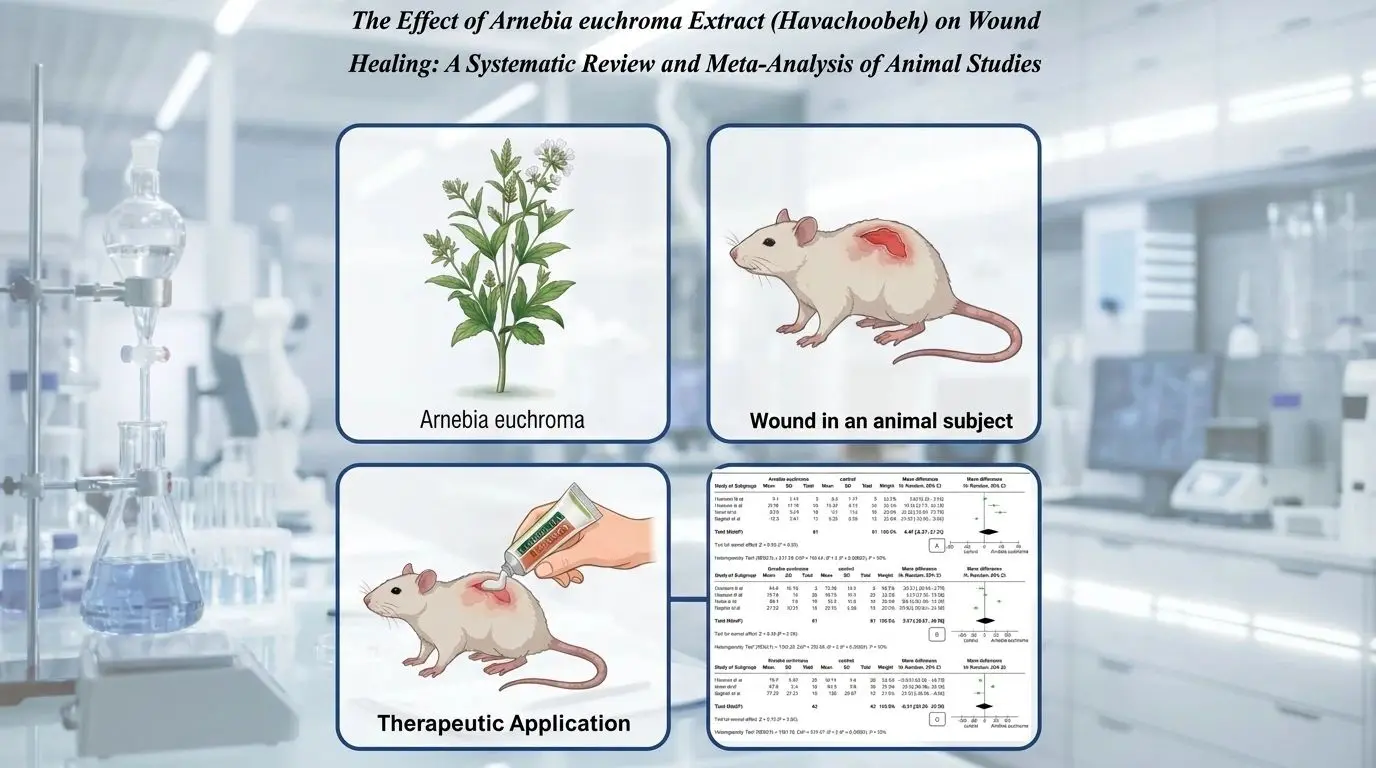
Background and purpose: This study aimed to systematically review and synthesise the existing evidence on the effects of Arnebia euchroma extract on wound healing. The primary objective was to evaluate its effects on wound closure, expressed as the percentage of wound healing, in animal models of different wound types, particularly second-degree burns and surgical wounds.
Materials and methods: A systematic review and meta-analysis was conducted using six databases: PubMed, Scopus, Cochrane Library, ICTRP, Google Scholar, and SID. Searches were conducted using predefined keywords, with no restrictions on publication date. Studies investigating the effects of A. euchroma extracts or products containing the extract on wound healing, compared with standard treatments or control groups, were eligible for inclusion. Data extraction and risk-of-bias assessment were performed using SYRCLE’s risk-of-bias tool. Following the removal of duplicates and exclusion of irrelevant records, five studies were included in the systematic review. All five studies were also included in the meta-analysis and were assessed as having a low risk of bias.
Results: Four studies reported wound-healing percentages at multiple time points following the induction of second-degree burns and were included in the meta-analysis. The pooled estimates showed that wound-healing percentages in the A. euchroma groups were comparable to those in the control groups across the follow-up periods, with no statistically significant differences. One study investigated surgical wounds and was synthesised qualitatively because of the limited evidence available for this wound type.
Conclusion: Evidence from animal models suggests that A. euchroma extract may achieve wound-healing outcomes comparable to those of control treatments in second-degree burn wounds. However, evidence regarding its effects on surgical wounds remains limited. Given the high heterogeneity and the small number of included studies, further well-designed studies with adequate sample sizes, standardised protocols, and consistent control treatments are needed to clarify the therapeutic potential of this plant extract.
Type of Study: Review |
Subject:
Traditional medicine
| Rights and permissions | |
 |
This work is licensed under a Creative Commons Attribution-NonCommercial 4.0 International License. |

Articles Copyright © The Author(s). Owned by Mazandaran University of Medical Sciences.
Contact Us
Address: Journal Office, Building No. 2, Mazandaran University of Medical Sciences, Moallem Square, Sari.Tel: +98 (011)34484874 Postal code: 48175-866 E-Mail: jmums@mazums.ac.ir Telefax: +98 (011)33262679
