

Volume 36, Issue 262 (Special Issue 2026)
J Mazandaran Univ Med Sci 2026, 36(262): 26-38 |
Back to browse issues page



Download citation:
BibTeX | RIS | EndNote | Medlars | ProCite | Reference Manager | RefWorks
Send citation to:


BibTeX | RIS | EndNote | Medlars | ProCite | Reference Manager | RefWorks
Send citation to:
Samsami S, Taher Dabagh A, Sabbagh S. Effectiveness of a Self-Management Programme in Improving Clinical Outcomes Among Older Adults with Knee Osteoarthritis. , J Mazandaran Univ Med Sci. 2026; 36 (262) :26-38
URL: http://jmums.mazums.ac.ir/article-1-23079-en.html
URL: http://jmums.mazums.ac.ir/article-1-23079-en.html


Abstract: (49 Views)
Abstract
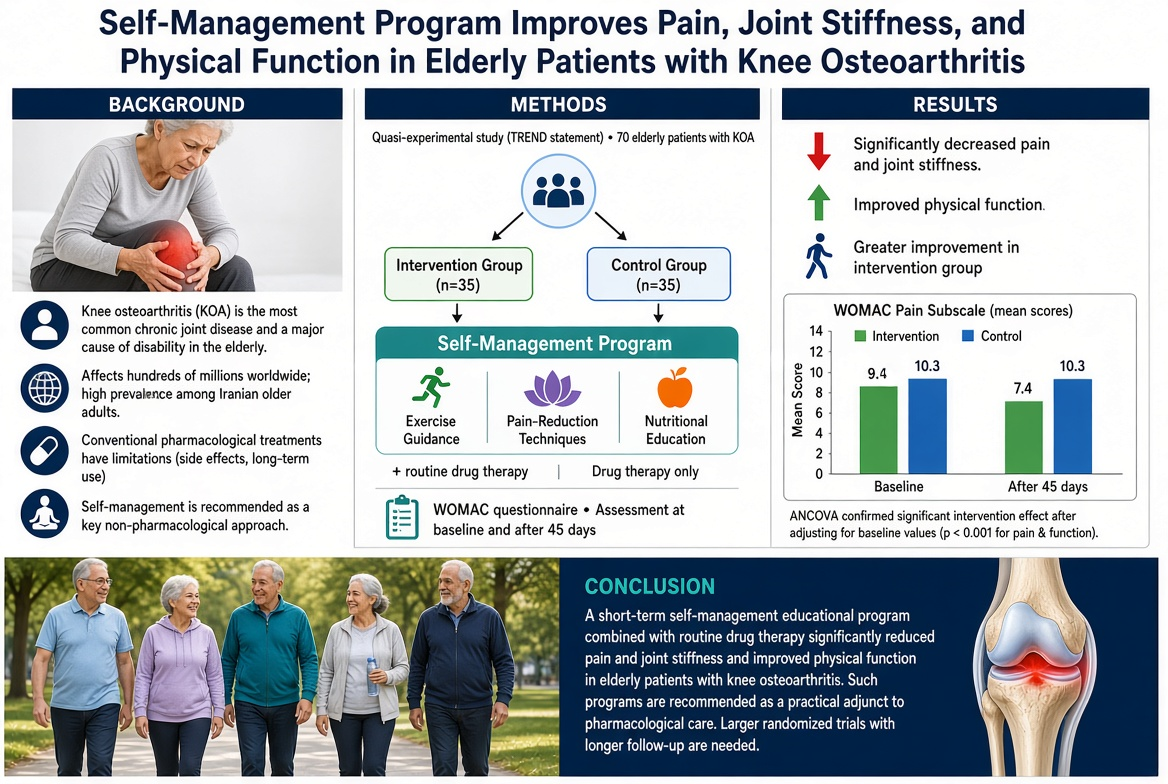
Background and purpose: Knee osteoarthritis (KOA) is the most common chronic joint disease and a leading cause of disability among older adults. This study aimed to investigate the effect of a self-management education programme on pain, joint stiffness, and physical function in patients with KOA referred to the orthopaedic clinic of Ganjavian Hospital in Dezful.
Materials and methods: This quasi-experimental study was conducted in accordance with the TREND statement. Of 200 elderly patients with KOA, 70 eligible participants were selected by convenience sampling and allocated to the intervention and control groups (n = 35 each) using a quasi-randomised (even–odd) method. The sample size was calculated based on a comparison of two means (α = 0.05, 80% power, effect size ≈ 0.7, and 10% dropout). Data were collected using the WOMAC questionnaire. The intervention group received an educational programme covering pain-reduction techniques, dietary modifications, physical exercise, and pharmacological treatment, while the control group received routine pharmacological treatment only. Assessments were performed at baseline and 45 days after the intervention. Data were analysed using SPSS version 18, with paired t-tests, the Wilcoxon test, the Mann–Whitney test, independent-samples t-tests, and analysis of covariance (ANCOVA) at a significance level of 0.05.
Results: At baseline, there were no significant differences between the groups. After the intervention, the intervention group showed significant reductions in pain (P< 0.001) and joint stiffness (P= 0.005) and a significant improvement in physical function (P< 0.001), while no significant changes were observed in the control group. The difference in mean total WOMAC scores between the groups was significant (P< 0.001). After adjusting for baseline values using ANCOVA, the intervention effect remained significant across all WOMAC dimensions.
Conclusion: A self-management educational programme may reduce pain and joint stiffness and improve physical function in patients with KOA. Such programmes may be used as an adjunct to pharmacological treatment; however, randomized studies with longer follow-up are needed to validate these findings.
Keywords: Knee Osteoarthritis, Self-Management, Pain Reduction, Joint Stiffness, Physical Function, Nutrition.
Type of Study: Research(Original) |
Subject:
Geriatrics
| Rights and permissions | |
 |
This work is licensed under a Creative Commons Attribution-NonCommercial 4.0 International License. |

Articles Copyright © The Author(s). Owned by Mazandaran University of Medical Sciences.
Contact Us
Address: Journal Office, Building No. 2, Mazandaran University of Medical Sciences, Moallem Square, Sari.Tel: +98 (011)34484874 Postal code: 48175-866 E-Mail: jmums@mazums.ac.ir Telefax: +98 (011)33262679
