

Volume 36, Issue 263 (11-2026)
J Mazandaran Univ Med Sci 2026, 36(263): 160-170 |
Back to browse issues page



Download citation:
BibTeX | RIS | EndNote | Medlars | ProCite | Reference Manager | RefWorks
Send citation to:


BibTeX | RIS | EndNote | Medlars | ProCite | Reference Manager | RefWorks
Send citation to:
Beiranvand S, Arsalani N, Hosseinabadi-farahani M, Vahedi M. Association Between Resilience and Clinical Performance Self-Efficacy Among Nurses Working in Hospitals Affiliated with the University of Social Welfare and Rehabilitation Sciences, Tehran, Iran. , J Mazandaran Univ Med Sci. 2026; 36 (263) :160-170
URL: http://jmums.mazums.ac.ir/article-1-23122-en.html
URL: http://jmums.mazums.ac.ir/article-1-23122-en.html


Abstract: (31 Views)
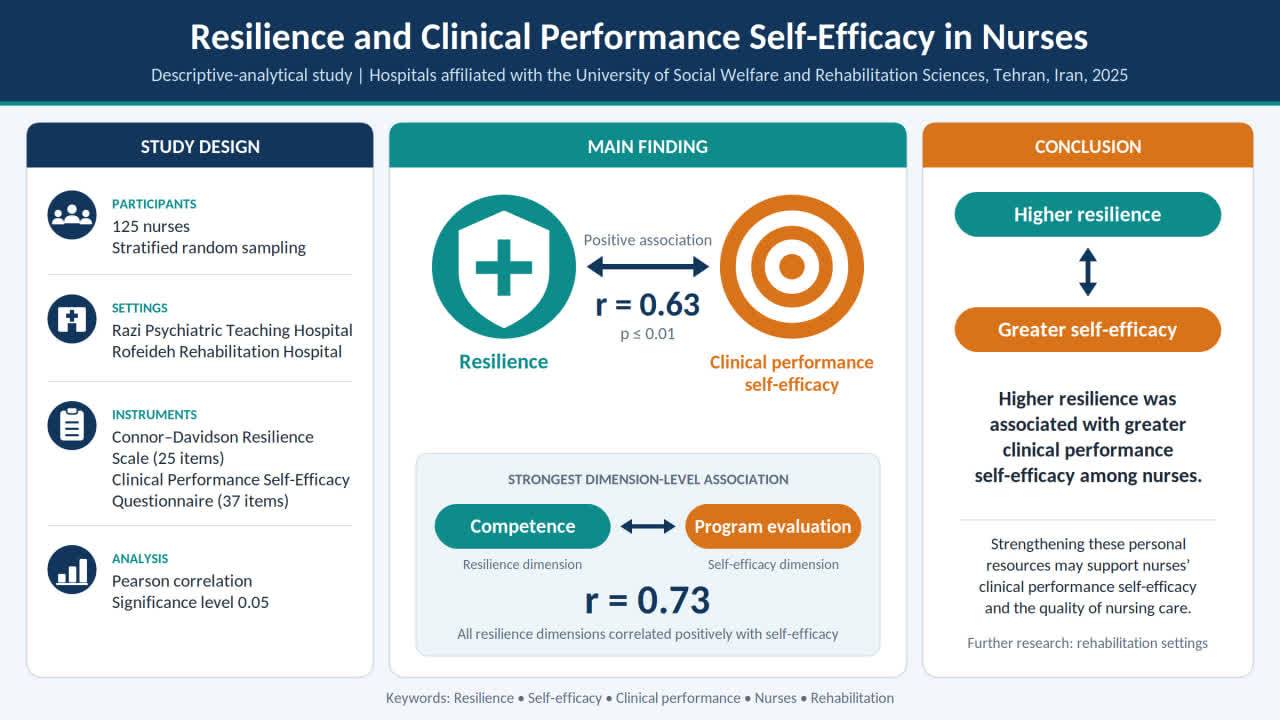
Background and purpose: Resilience and clinical performance self-efficacy are important personal resources that help nurses cope with occupational stress and provide high-quality care. However, evidence regarding the relationship between these factors, particularly among nurses working in rehabilitation hospitals, remains limited. This study aimed to examine the association between resilience and clinical performance self-efficacy among nurses working in hospitals affiliated with the University of Rehabilitation Sciences and Social Health in Tehran, Iran.
Materials and methods: This descriptive-analytical study included 125 nurses working at Razi Psychiatric Teaching Hospital and Rofeideh Rehabilitation Hospital, affiliated with the University of Rehabilitation Sciences and Social Health in Tehran, Iran. Participants were selected using stratified random sampling. Data were collected using a demographic questionnaire, the 25-item Connor-Davidson Resilience Scale, and the 37-item Clinical Performance Self-Efficacy Questionnaire. Data normality was assessed using the Kolmogorov-Smirnov test and skewness and kurtosis indices. One-sample t-tests were used to compare the mean scores for each variable with the corresponding theoretical scale midpoint. Associations between variables were examined using Pearson’s correlation coefficient. Statistical significance was set at P < 0.05.
Results: ost participants were female (61.7%), held a bachelor’s degree (60.5%), were aged 36-40 years (39.5%), and had 11-15 years of work experience (34.6%). The mean ± standard deviation scores for resilience and clinical performance self-efficacy were 75.50 ± 4.0 and 69.06 ± 0.50, respectively. Resilience was positively correlated with clinical performance self-efficacy (r = 0.63, P ≤ 0.01). All dimensions of resilience were also positively correlated with clinical performance self-efficacy. The strongest correlation was observed between the competence dimension of resilience and the programme evaluation dimension of self-efficacy (r = 0.73, P ≤ 0.01)
Conclusion: Greater resilience was associated with higher clinical performance self-efficacy among nurses. Interventions aimed at strengthening resilience may warrant investigation as a potential means of supporting nurses’ confidence in their clinical performance and, ultimately, the quality of nursing care. Further research, particularly in rehabilitation settings, is needed to clarify these relationships and assess their practical implications.
Type of Study: Research(Original) |
Subject:
nursing
Send email to the article author
| Rights and permissions | |
 |
This work is licensed under a Creative Commons Attribution-NonCommercial 4.0 International License. |

Articles Copyright © The Author(s). Owned by Mazandaran University of Medical Sciences.
Contact Us
Address: Journal Office, Building No. 2, Mazandaran University of Medical Sciences, Moallem Square, Sari.Tel: +98 (011)34484874 Postal code: 48175-866 E-Mail: jmums@mazums.ac.ir Telefax: +98 (011)33262679
