

Volume 36, Issue 261 (10-2026)
J Mazandaran Univ Med Sci 2026, 36(261): 41-54 |
Back to browse issues page



Download citation:
BibTeX | RIS | EndNote | Medlars | ProCite | Reference Manager | RefWorks
Send citation to:


BibTeX | RIS | EndNote | Medlars | ProCite | Reference Manager | RefWorks
Send citation to:
Rezazadeh F, Dehghani M, Aali S, Naderi Z, Fahimi P. Comparison of Ground Reaction Force, Free Torque, and Impulse in Male Athletes with Hamstring Injury and Healthy Controls During Running with a Deliberate Change of Direction. J Mazandaran Univ Med Sci 2026; 36 (261) :41-54
URL: http://jmums.mazums.ac.ir/article-1-23208-en.html
URL: http://jmums.mazums.ac.ir/article-1-23208-en.html


Abstract: (26 Views)
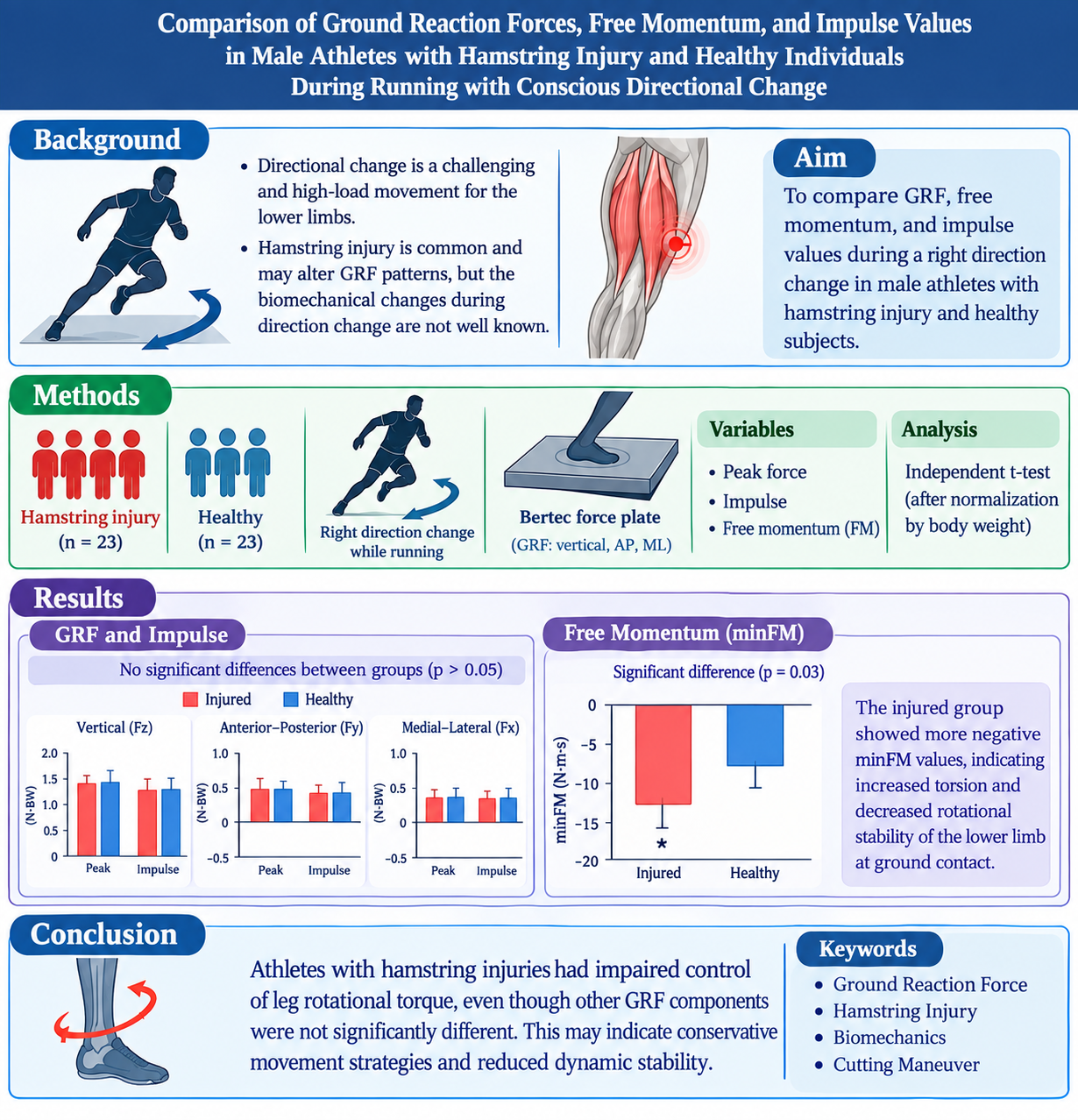
Background and purpose: Intentional change of direction is considered one of the most challenging sports skills because of the high mechanical loads imposed on the lower limbs. Hamstring injury is among the most common injuries in athletes and may affect ground reaction force (GRF) patterns. However, the biomechanical changes associated with hamstring injury during a change of direction have not been well characterised. Therefore, this study aimed to compare GRF, free torque, and impulse during running with a deliberate change of direction to the right between male athletes with hamstring injury and healthy controls.
Materials and methods: In this cross-sectional comparative study, 46 male athletes (23 injured and 23 healthy) participated. GRF was recorded in three directions - vertical, anterior-posterior, and medial-lateral - using a Bertec force plate during a rightward change-of-direction manoeuvre. The peak force, impulse, and free torque variables were extracted and analysed using an independent-samples t-test after normalisation to body weight.
Results: There were no significant differences between the two groups (P> 0.05) in most GRF variables, including peak vertical, anterior-posterior, and medial-lateral forces, as well as impulse and vertical force (Fz). In contrast, the minimum free torque (minFM) differed significantly between groups (P= 0.03), with the injured group showing more negative values, which may indicate greater torsional loading and reduced rotational stability of the lower limb at ground contact.
Conclusion: The findings indicate that athletes with hamstring injuries may have impaired control of lower-limb rotational torque, despite the absence of significant differences in other GRF variables. This finding may reflect the adoption of conservative movement strategies and reduced dynamic stability.
Materials and methods: In this cross-sectional comparative study, 46 male athletes (23 injured and 23 healthy) participated. GRF was recorded in three directions - vertical, anterior-posterior, and medial-lateral - using a Bertec force plate during a rightward change-of-direction manoeuvre. The peak force, impulse, and free torque variables were extracted and analysed using an independent-samples t-test after normalisation to body weight.
Results: There were no significant differences between the two groups (P> 0.05) in most GRF variables, including peak vertical, anterior-posterior, and medial-lateral forces, as well as impulse and vertical force (Fz). In contrast, the minimum free torque (minFM) differed significantly between groups (P= 0.03), with the injured group showing more negative values, which may indicate greater torsional loading and reduced rotational stability of the lower limb at ground contact.
Conclusion: The findings indicate that athletes with hamstring injuries may have impaired control of lower-limb rotational torque, despite the absence of significant differences in other GRF variables. This finding may reflect the adoption of conservative movement strategies and reduced dynamic stability.
Type of Study: Research(Original) |
Subject:
Sport Physiology
Send email to the article author
| Rights and permissions | |
 |
This work is licensed under a Creative Commons Attribution-NonCommercial 4.0 International License. |

Articles Copyright © The Author(s). Owned by Mazandaran University of Medical Sciences.
Contact Us
Address: Journal Office, Building No. 2, Mazandaran University of Medical Sciences, Moallem Square, Sari.Tel: +98 (011)34484874 Postal code: 48175-866 E-Mail: jmums@mazums.ac.ir Telefax: +98 (011)33262679
