

Volume 36, Issue 263 (11-2026)
J Mazandaran Univ Med Sci 2026, 36(263): 112-123 |
Back to browse issues page



Download citation:
BibTeX | RIS | EndNote | Medlars | ProCite | Reference Manager | RefWorks
Send citation to:


BibTeX | RIS | EndNote | Medlars | ProCite | Reference Manager | RefWorks
Send citation to:
Ziaei Hezarjaribi H, Fallahi Lima A, Afsharzadeh S, Hatamipour H. Comparative Evaluation of Microscopic and Molecular Methods for the Diagnosis of Cutaneous Leishmaniasis in Two Endemic Foci in Northern and Central Iran, 2024-2026. , J Mazandaran Univ Med Sci. 2026; 36 (263) :112-123
URL: http://jmums.mazums.ac.ir/article-1-23294-en.html
URL: http://jmums.mazums.ac.ir/article-1-23294-en.html


Abstract: (32 Views)
Background and purpose: Cutaneous leishmaniasis (CL) is an important endemic parasitic disease in several regions of Iran. Although direct microscopy is widely used for diagnosis, its sensitivity may be limited, particularly in specimens with low parasite loads. This study aimed to compare the detection of Leishmania infection by direct microscopic examination and conventional polymerase chain reaction (PCR) in patients with suspected CL from two endemic foci in northern and central Iran.
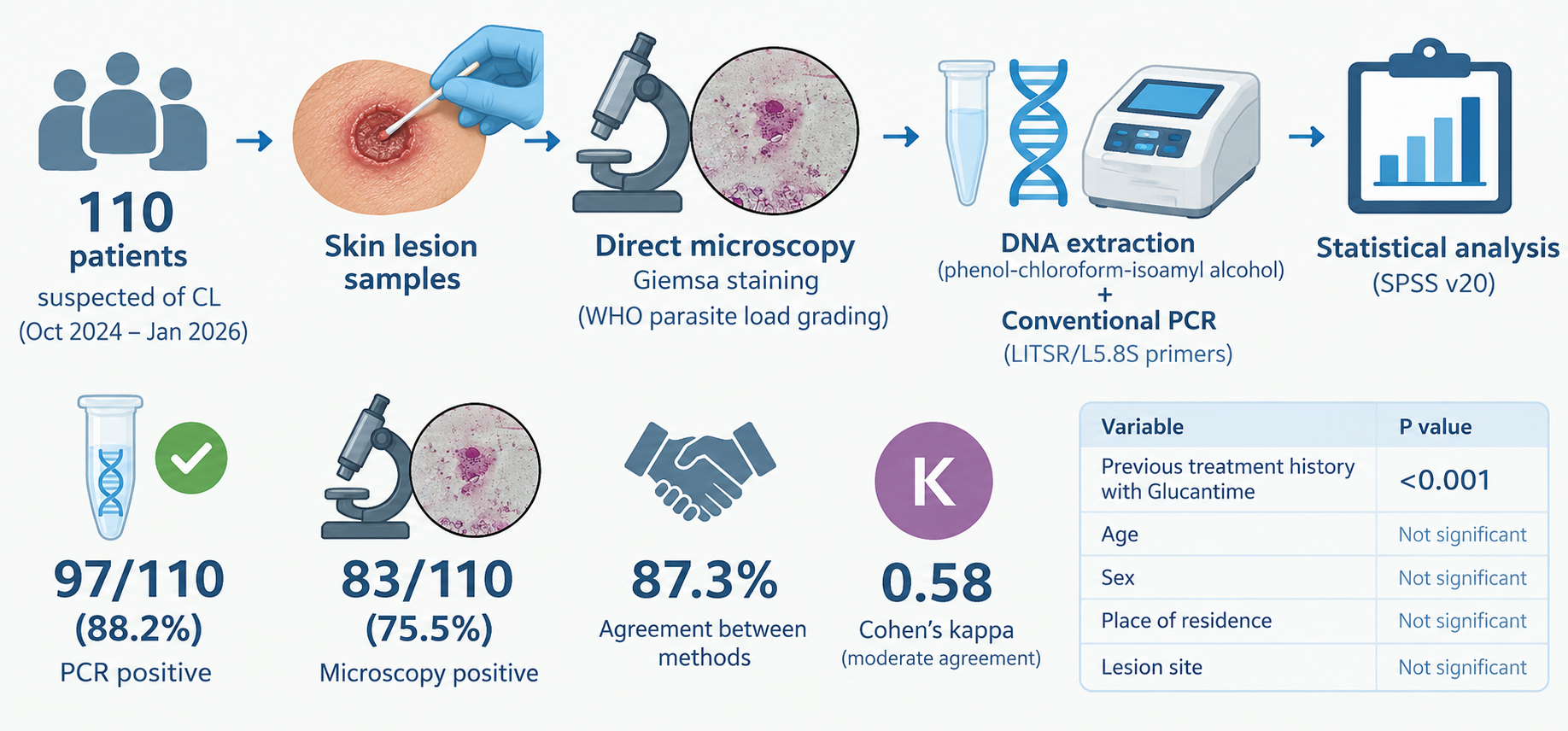
Materials and methods: This comparative cross-sectional study was conducted between October 2024 and January 2026 and included 110 individuals with suspected cutaneous leishmaniasis attending healthcare centers in Golestan and Semnan Provinces. Demographic and clinical data were collected using a questionnaire, and samples were obtained from skin lesions. Microscopic examination was performed using Giemsa staining, and parasite load was graded according to the World Health Organization protocol. DNA was extracted using the phenol-chloroform-isoamyl alcohol method, and Leishmania DNA was detected by conventional PCR using the LITSR/L5.8S primer pair. Statistical analyses were performed using SPSS version 20.
Results: Of the 110 samples, 97 (88.2%) were PCR-positive, compared with 83 (75.5%) that were positive by direct microscopic examination. The overall agreement between the two methods was 87.3%, with a Cohen's kappa coefficient of 0.58, indicating moderate agreement. A significant association was found between a history of previous treatment with Glucantime and the results of both diagnostic methods (P < 0.001). In contrast, age, sex, place of residence and lesion site were not significantly associated with the diagnostic results. The hands were the most frequently affected site, accounting for 49.1% of lesions.
Conclusion: Conventional PCR detected a higher proportion of positive cases than direct microscopy among patients with suspected cutaneous leishmaniasis. Using molecular and microscopic methods in combination may improve the laboratory detection of CL, particularly in endemic regions of Iran.
Type of Study: Research(Original) |
Subject:
parasitology
Send email to the article author
| Rights and permissions | |
 |
This work is licensed under a Creative Commons Attribution-NonCommercial 4.0 International License. |

Articles Copyright © The Author(s). Owned by Mazandaran University of Medical Sciences.
Contact Us
Address: Journal Office, Building No. 2, Mazandaran University of Medical Sciences, Moallem Square, Sari.Tel: +98 (011)34484874 Postal code: 48175-866 E-Mail: jmums@mazums.ac.ir Telefax: +98 (011)33262679
