

Volume 36, Issue 263 (11-2026)
J Mazandaran Univ Med Sci 2026, 36(263): 63-75 |
Back to browse issues page



Download citation:
BibTeX | RIS | EndNote | Medlars | ProCite | Reference Manager | RefWorks
Send citation to:


BibTeX | RIS | EndNote | Medlars | ProCite | Reference Manager | RefWorks
Send citation to:
Hajialibeig A, Kholerdi N, Varshoei F, Rostami-Maskopaee F, Hosseinzadeh F, Rezai M S. lAge-Adjusted Monocytosis and Clinical Outcomes in Hospitalized Children with COVID-19 and MIS-C: A Retrospective Observational Study. , J Mazandaran Univ Med Sci. 2026; 36 (263) :63-75
URL: http://jmums.mazums.ac.ir/article-1-23453-en.html
URL: http://jmums.mazums.ac.ir/article-1-23453-en.html
Azin Hajialibeig 
 , Nima Kholerdi , Fatemeh Varshoei , Fereshteh Rostami-Maskopaee , Fatemeh Hosseinzadeh , Mohammad Sadegh Rezai *
Abstract: (33 Views)
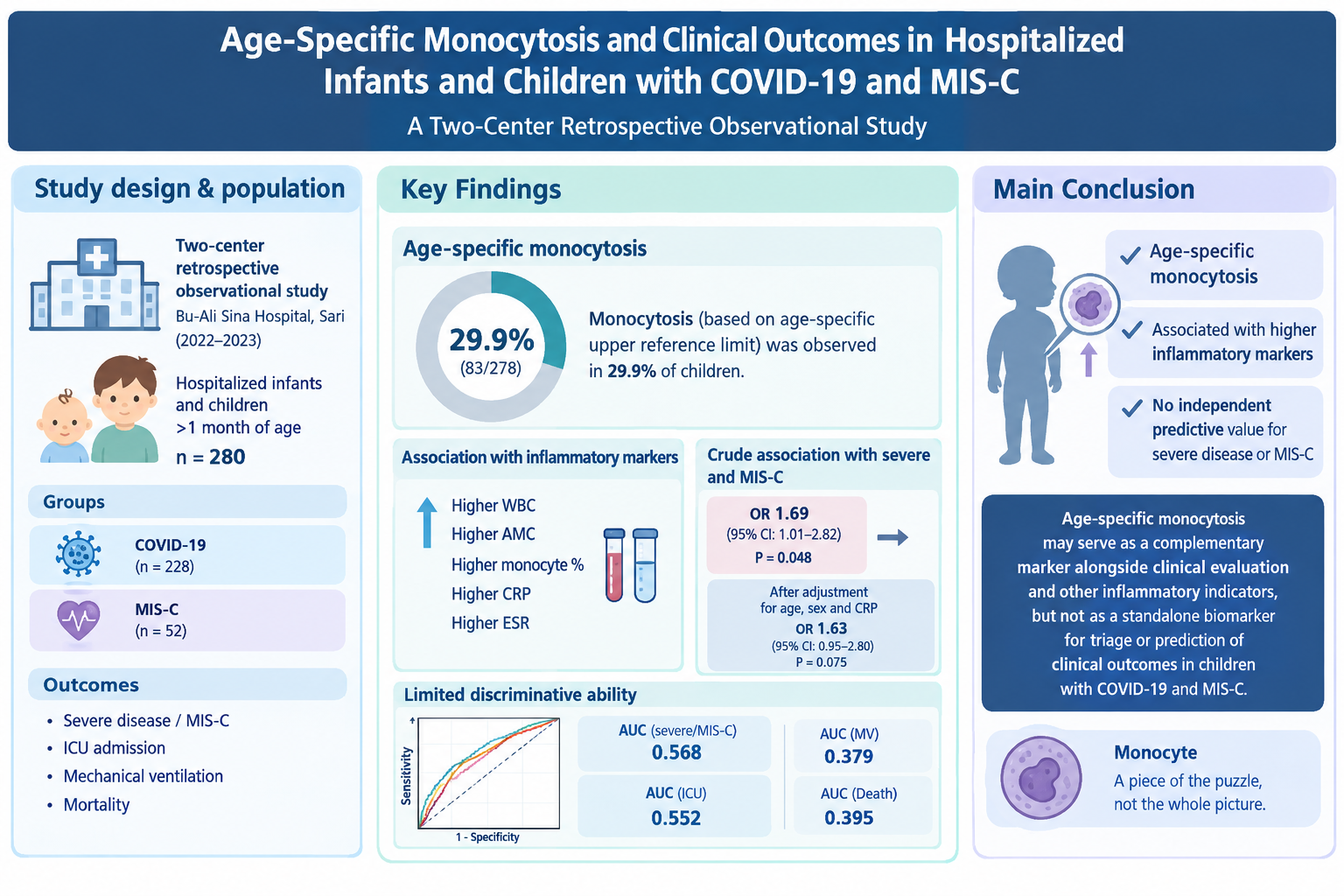
Background and purpose: The role of monocytes in the inflammatory response to COVID-19 and multisystem inflammatory syndrome in children (MIS-C) is important; however, interpretation of monocyte counts in paediatric patients is complicated by age-related variations in reference ranges. This study aimed to determine the prevalence of age-adjusted monocytosis and examine its association with clinical outcomes in hospitalized infants and children with COVID-19 and MIS-C.
Materials and methods: In this retrospective observational study, children hospitalized at Bu-Ali Sina Hospital in Sari between 2022 and 2024 were evaluated. The study population comprised children aged over one month. The absolute monocyte count (AMC) was calculated from the white blood cell (WBC) count and monocyte percentage, and monocytosis was defined according to age-specific upper reference limits. Data were analysed using non-parametric tests, the chi-square or Fisher's exact test, Spearman's correlation, exploratory logistic regression, and receiver operating characteristic (ROC) curve analysis.
Results: Of the 280 eligible children, monocyte data were available for 278. The median age was 13 months; 150 children were male, 42 required ICU admission, five received mechanical ventilation, and four died. Age-adjusted monocytosis was identified in 83 children (29.9%) and was associated with higher WBC counts, AMC, monocyte percentages, CRP, and ESR. In the unadjusted analysis, monocytosis was associated with severe COVID-19 or MIS-C (OR = 1.69; 95% CI: 1.01–2.82; P = 0.048). However, this association was no longer statistically significant after adjustment for age, sex, and CRP (adjusted OR = 1.63; 95% CI: 0.95–2.80; P = 0.075). AMC alone showed limited discriminatory ability for severe disease, MIS-C, and ICU admission.
Conclusion: AMC was relatively common among hospitalized children with COVID-19 and MIS-C and was associated with some inflammatory markers. However, it had limited discriminatory ability when used alone and, after adjustment, showed no significant association with disease severity or the presence of MIS-C. The findings of this study do not support the use of AMC as an independent marker for triage or prediction of clinical outcomes; however, it may serve as a complementary indicator alongside clinical assessment and other inflammatory markers.
Type of Study: Research(Original) |
Subject:
Pediatric Infectious Disease
Send email to the article author
| Rights and permissions | |
 |
This work is licensed under a Creative Commons Attribution-NonCommercial 4.0 International License. |

Articles Copyright © The Author(s). Owned by Mazandaran University of Medical Sciences.
Contact Us
Address: Journal Office, Building No. 2, Mazandaran University of Medical Sciences, Moallem Square, Sari.Tel: +98 (011)34484874 Postal code: 48175-866 E-Mail: jmums@mazums.ac.ir Telefax: +98 (011)33262679
