

Volume 35, Issue 252 (12-2025)
J Mazandaran Univ Med Sci 2025, 35(252): 125-131 |
Back to browse issues page


Download citation:
BibTeX | RIS | EndNote | Medlars | ProCite | Reference Manager | RefWorks
Send citation to:


BibTeX | RIS | EndNote | Medlars | ProCite | Reference Manager | RefWorks
Send citation to:
Babamahmoodi F, Babamahmoodi A. Breast Tuberculosis or Cancer? Reporting a Common Diagnostic Error. J Mazandaran Univ Med Sci 2025; 35 (252) :125-131
URL: http://jmums.mazums.ac.ir/article-1-21743-en.html
URL: http://jmums.mazums.ac.ir/article-1-21743-en.html


Abstract: (212 Views)
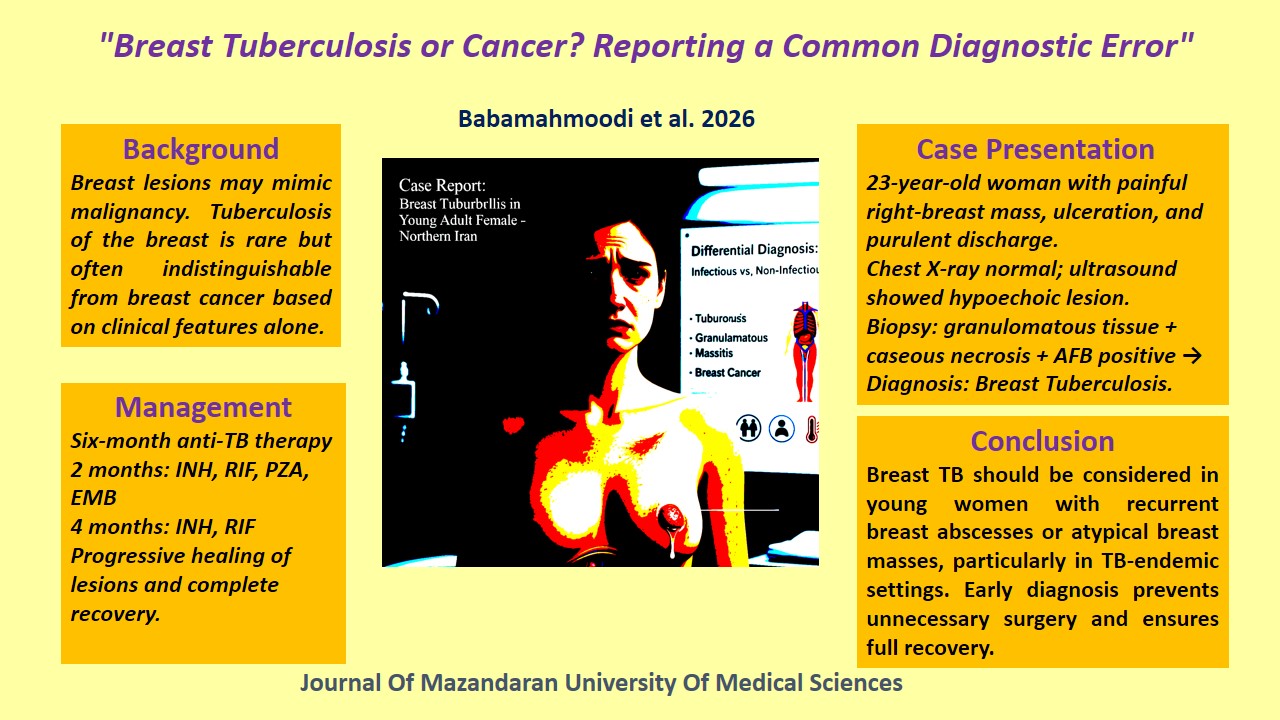
Breast lesions in women often pose diagnostic challenges. Infectious causes like tuberculosis (TB) can easily be mistaken for malignancies such as breast cancer due to similar clinical features. This report examines a rare case of breast TB in a 23-year-old woman from northern Iran, who initially presented with a lump in her right breast. The differential diagnoses included both infectious and non-infectious causes, ultimately leading to a diagnosis of breast TB through paraclinical evaluations. Clinical symptoms included hyperesthesia, pain, and erythema around the areola, followed by purulent discharge. The patient denied any systemic symptoms such as fever or night sweats, as well as any family history of breast cancer or contact with individuals suspected of TB.
Eight months prior to presentation, similar symptoms in the left breast were treated as a pyogenic abscess with antibiotics, albeit without microbiological confirmation. Following a recurrence of symptoms in her right breast and a lack of improvement with antibiotic treatment, she was referred to our center for further evaluation. Initial microbiological tests, including acid-fast bacilli (AFB) staining from breast discharge, were negative. Ultrasound imaging revealed a hypoechoic mass with ductal ectasia, and a biopsy indicated granulomatous inflammation with caseous necrosis and the presence of AFB in the tissue smear.
The patient was treated with a standard four-drug anti-tuberculosis regimen of isoniazid, rifampin, ethambutol, and pyrazinamide. Follow-up visits indicated gradual improvement in her lesions. After two months, treatment continued with isoniazid and rifampin for an additional four months, completing a six-month regimen. The HIV test was negative. Six months after discontinuing the medication, the patient remained asymptomatic with no signs of recurrence.
Though rare, breast TB emphasizes the need to include TB in the differential diagnosis of breast masses, especially in areas with high TB prevalence and lower breast cancer likelihood, to avoid unnecessary interventions.
Eight months prior to presentation, similar symptoms in the left breast were treated as a pyogenic abscess with antibiotics, albeit without microbiological confirmation. Following a recurrence of symptoms in her right breast and a lack of improvement with antibiotic treatment, she was referred to our center for further evaluation. Initial microbiological tests, including acid-fast bacilli (AFB) staining from breast discharge, were negative. Ultrasound imaging revealed a hypoechoic mass with ductal ectasia, and a biopsy indicated granulomatous inflammation with caseous necrosis and the presence of AFB in the tissue smear.
The patient was treated with a standard four-drug anti-tuberculosis regimen of isoniazid, rifampin, ethambutol, and pyrazinamide. Follow-up visits indicated gradual improvement in her lesions. After two months, treatment continued with isoniazid and rifampin for an additional four months, completing a six-month regimen. The HIV test was negative. Six months after discontinuing the medication, the patient remained asymptomatic with no signs of recurrence.
Though rare, breast TB emphasizes the need to include TB in the differential diagnosis of breast masses, especially in areas with high TB prevalence and lower breast cancer likelihood, to avoid unnecessary interventions.
Type of Study: Case Report |
Subject:
infection
Send email to the article author
| Rights and permissions | |
 |
This work is licensed under a Creative Commons Attribution-NonCommercial 4.0 International License. |

Articles Copyright © The Author(s). Owned by Mazandaran University of Medical Sciences.
Contact Us
Address: Journal Office, Building No. 2, Mazandaran University of Medical Sciences, Moallem Square, Sari.Tel: +98 (011)34484874 Postal code: 48175-866 E-Mail: jmums@mazums.ac.ir Telefax: +98 (011)33262679
