

Volume 35, Issue 252 (12-2025)
J Mazandaran Univ Med Sci 2025, 35(252): 118-124 |
Back to browse issues page



Download citation:
BibTeX | RIS | EndNote | Medlars | ProCite | Reference Manager | RefWorks
Send citation to:


BibTeX | RIS | EndNote | Medlars | ProCite | Reference Manager | RefWorks
Send citation to:
Azadbakht M, Moosazadeh M, Aliasghari M, Kalantari R. Selected Scholars in The Shahid Sayad Shirazi Program at Iranian Universities: A Focus on Top Graduates from Mazandaran Province. J Mazandaran Univ Med Sci 2025; 35 (252) :118-124
URL: http://jmums.mazums.ac.ir/article-1-21916-en.html
URL: http://jmums.mazums.ac.ir/article-1-21916-en.html


Abstract: (2457 Views)
Background and purpose: This study examined the demographic and academic characteristics of a cohort of scholars from Mazandaran Province who were admitted to the Shahid Sayad Shirazi Program across Iranian universities. The National Elites Foundation (NEF) annually awards military service exemptions to leverage the scientific, cultural, and technological capacities of outstanding graduates. Using NEF database records, this study describes the distribution of academic disciplines, graduating universities, grade point averages, and marital status of awardees from Mazandaran Province during the period 2007–2023.
Materials and methods: This descriptive, cross-sectional study analyzed data obtained from the NEF database. All eligible applicants from Mazandaran Province who participated in the program between 2007 and 2023 (1386–1402) were included. Extracted variables comprised academic discipline, marital status, university of graduation, overall grade point average, and admission status. Data were analyzed using descriptive statistics, including means, standard deviations, percentages, and frequencies.
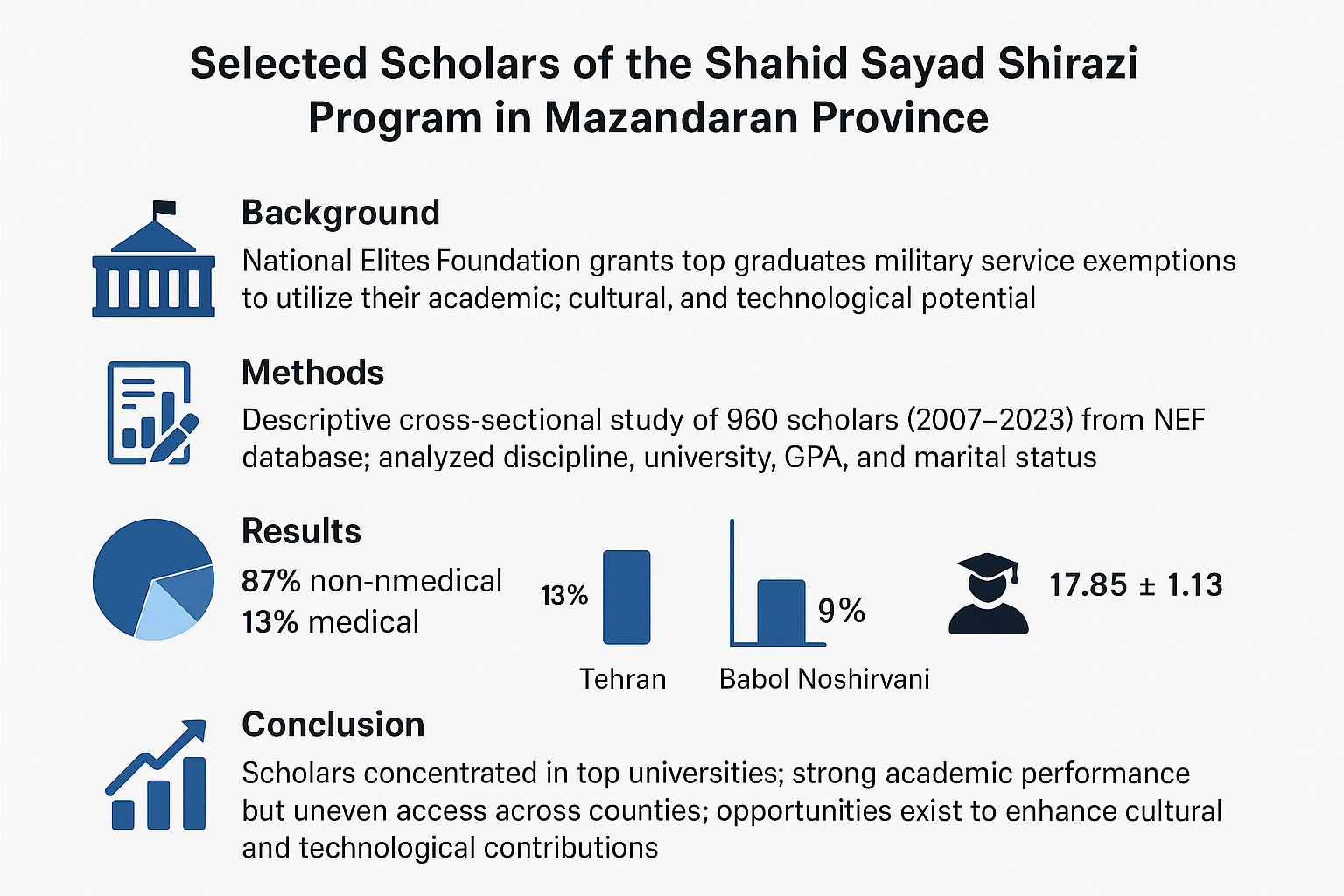
Results: A total of 960 scholars from Mazandaran Province were registered in the program during the study period. Of these, 87% were enrolled in non-medical disciplines, while 13% pursued medical sciences. The University of Tehran accounted for the largest share of awardees (15%), followed by Babol Noshirvani University of Technology (8%). The mean grade point average was 17.85 ± 1.13. In terms of marital status, 59% of awardees were single and 41% were married.
Conclusion: The findings reveal that the majority of participating scholars were concentrated in non-medical disciplines and leading national universities, and their consistently high GPAs demonstrate strong academic achievement. The uneven geographic distribution of elites across the province indicates disparities in access to educational resources. Despite their academic excellence, the full technological and cultural potential of this group remains largely untapped. Enhancing university infrastructure, increasing awareness of the program, expanding career opportunities, and fostering greater disciplinary diversity could significantly improve the impact and effectiveness of the Shahid Sayad Shirazi Program in Mazandaran Province.
Materials and methods: This descriptive, cross-sectional study analyzed data obtained from the NEF database. All eligible applicants from Mazandaran Province who participated in the program between 2007 and 2023 (1386–1402) were included. Extracted variables comprised academic discipline, marital status, university of graduation, overall grade point average, and admission status. Data were analyzed using descriptive statistics, including means, standard deviations, percentages, and frequencies.
Results: A total of 960 scholars from Mazandaran Province were registered in the program during the study period. Of these, 87% were enrolled in non-medical disciplines, while 13% pursued medical sciences. The University of Tehran accounted for the largest share of awardees (15%), followed by Babol Noshirvani University of Technology (8%). The mean grade point average was 17.85 ± 1.13. In terms of marital status, 59% of awardees were single and 41% were married.
Conclusion: The findings reveal that the majority of participating scholars were concentrated in non-medical disciplines and leading national universities, and their consistently high GPAs demonstrate strong academic achievement. The uneven geographic distribution of elites across the province indicates disparities in access to educational resources. Despite their academic excellence, the full technological and cultural potential of this group remains largely untapped. Enhancing university infrastructure, increasing awareness of the program, expanding career opportunities, and fostering greater disciplinary diversity could significantly improve the impact and effectiveness of the Shahid Sayad Shirazi Program in Mazandaran Province.
Type of Study: Brief Report |
Subject:
Policy and Management
Send email to the article author
| Rights and permissions | |
 |
This work is licensed under a Creative Commons Attribution-NonCommercial 4.0 International License. |

Articles Copyright © The Author(s). Owned by Mazandaran University of Medical Sciences.
Contact Us
Address: Journal Office, Building No. 2, Mazandaran University of Medical Sciences, Moallem Square, Sari.Tel: +98 (011)34484874 Postal code: 48175-866 E-Mail: jmums@mazums.ac.ir Telefax: +98 (011)33262679
