

Volume 36, Issue 260 (9-2026)
J Mazandaran Univ Med Sci 2026, 36(260): 129-138 |
Back to browse issues page



Download citation:
BibTeX | RIS | EndNote | Medlars | ProCite | Reference Manager | RefWorks
Send citation to:


BibTeX | RIS | EndNote | Medlars | ProCite | Reference Manager | RefWorks
Send citation to:
Hormozi M, Dehghan Haghighi J, Komeili A, Laal F, Akbari M M. Factors Associated with Changes in Hearing Thresholds among Workers in the Zahedan Flour Industry over a Five-Year Period. J Mazandaran Univ Med Sci 2026; 36 (260) :129-138
URL: http://jmums.mazums.ac.ir/article-1-22909-en.html
URL: http://jmums.mazums.ac.ir/article-1-22909-en.html


Abstract: (13 Views)
Background and purpose: Hearing loss is one of the major occupational health problems associated with exposure to noisy environments in both industrialized and developing countries. Although noise-induced hearing loss is irreversible, it is largely preventable. This study aimed to investigate the five-year trend in hearing thresholds and associated factors among flour industry workers in Zahedan between 2017 and 2021.
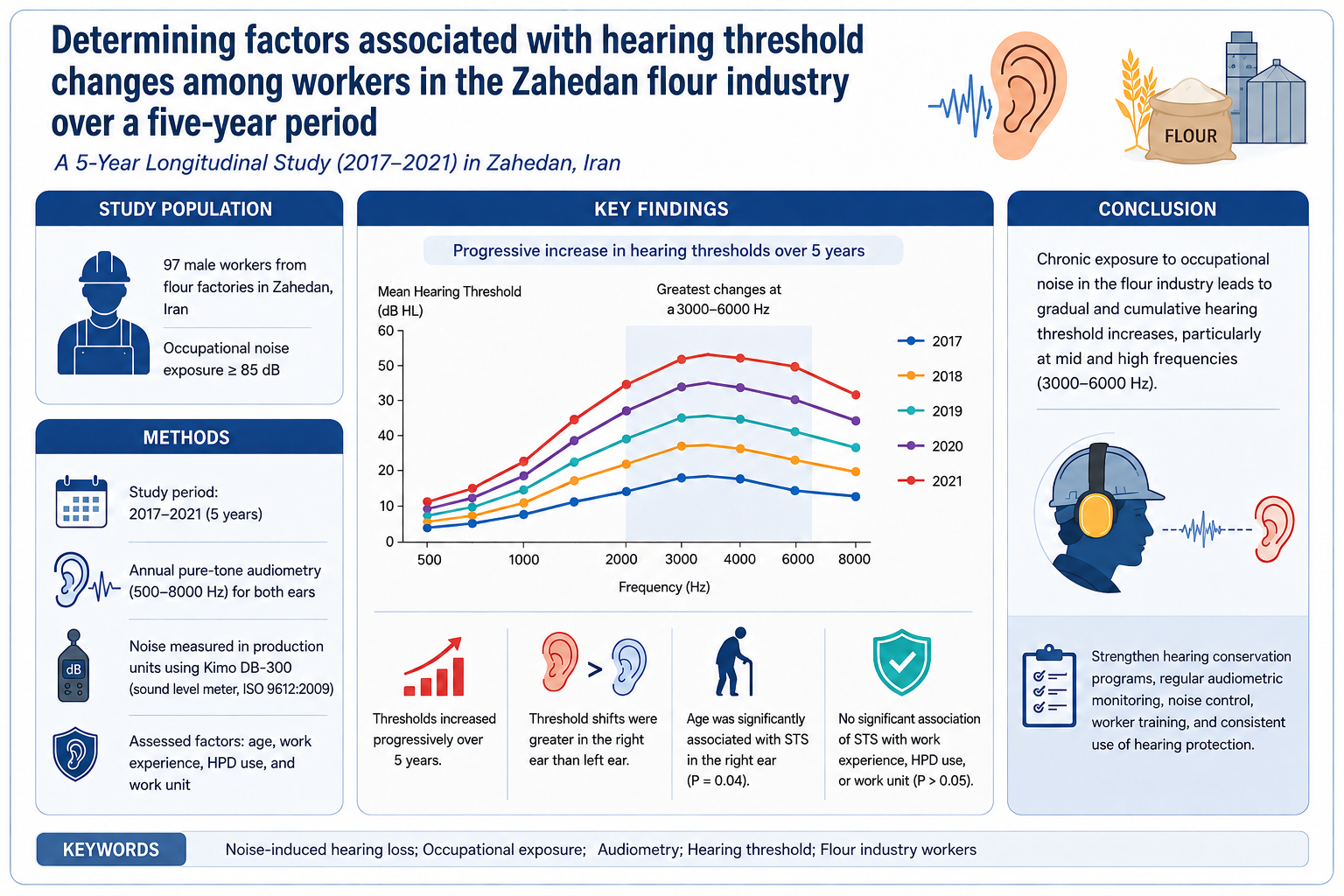
Materials and methods: This retrospective descriptive-analytical study was based on pure-tone audiometry data from 97 male workers exposed to occupational noise levels of ≥85 dBA. Hearing thresholds at frequencies ranging from 500 to 8000 Hz were extracted for both ears, and standard threshold shift (STS) were calculated at 2000, 3000, and 4000 Hz frequencies. Sound pressure levels were measured in different sections of the production lines using a Kimo DB 300 sound level meter. The associations of age, work experience, and hearing protection device use with changes in hearing thresholds were also assessed statistically.
Results: The mean sound pressure level in the production units was 91.38 ± 2.62 dB, exceeding the permissible occupational exposure limit. Hearing thresholds increased progressively over the five-year period, with the greatest changes observed at mid- and high-frequency ranges (3000–6000 Hz). The association between age and standard threshold shift (STS) was statistically significant only in the right ear (P = 0.04). No statistically significant associations were observed between changes in hearing thresholds and work experience, hearing protection device use, or work unit (P > 0.05). Hearing threshold shifts were greater in the right ear than in the left ear.
Conclusion: The findings indicate that prolonged exposure to occupational noise was associated with progressive increases in hearing thresholds among flour industry workers. Age was significantly associated with standard threshold shift in the right ear, whereas work experience, hearing protection device use, and work unit were not significantly associated with changes in hearing thresholds. These findings highlight the importance of strengthening hearing conservation programs, improving worker training, and implementing regular audiometric monitoring to support the early detection and prevention of occupational hearing loss.
Materials and methods: This retrospective descriptive-analytical study was based on pure-tone audiometry data from 97 male workers exposed to occupational noise levels of ≥85 dBA. Hearing thresholds at frequencies ranging from 500 to 8000 Hz were extracted for both ears, and standard threshold shift (STS) were calculated at 2000, 3000, and 4000 Hz frequencies. Sound pressure levels were measured in different sections of the production lines using a Kimo DB 300 sound level meter. The associations of age, work experience, and hearing protection device use with changes in hearing thresholds were also assessed statistically.
Results: The mean sound pressure level in the production units was 91.38 ± 2.62 dB, exceeding the permissible occupational exposure limit. Hearing thresholds increased progressively over the five-year period, with the greatest changes observed at mid- and high-frequency ranges (3000–6000 Hz). The association between age and standard threshold shift (STS) was statistically significant only in the right ear (P = 0.04). No statistically significant associations were observed between changes in hearing thresholds and work experience, hearing protection device use, or work unit (P > 0.05). Hearing threshold shifts were greater in the right ear than in the left ear.
Conclusion: The findings indicate that prolonged exposure to occupational noise was associated with progressive increases in hearing thresholds among flour industry workers. Age was significantly associated with standard threshold shift in the right ear, whereas work experience, hearing protection device use, and work unit were not significantly associated with changes in hearing thresholds. These findings highlight the importance of strengthening hearing conservation programs, improving worker training, and implementing regular audiometric monitoring to support the early detection and prevention of occupational hearing loss.
Type of Study: Research(Original) |
Subject:
Health Professiona
Send email to the article author
| Rights and permissions | |
 |
This work is licensed under a Creative Commons Attribution-NonCommercial 4.0 International License. |

Articles Copyright © The Author(s). Owned by Mazandaran University of Medical Sciences.
Contact Us
Address: Journal Office, Building No. 2, Mazandaran University of Medical Sciences, Moallem Square, Sari.Tel: +98 (011)34484874 Postal code: 48175-866 E-Mail: jmums@mazums.ac.ir Telefax: +98 (011)33262679
