

Volume 36, Issue 260 (9-2026)
J Mazandaran Univ Med Sci 2026, 36(260): 258-272 |
Back to browse issues page



Download citation:
BibTeX | RIS | EndNote | Medlars | ProCite | Reference Manager | RefWorks
Send citation to:


BibTeX | RIS | EndNote | Medlars | ProCite | Reference Manager | RefWorks
Send citation to:
Salehi A, Shahhosseini Z, Hamzehgardeshi Z, Azizi D. The Role of Social Networks in Promoting or Discouraging Childbearing: A Scoping Review. J Mazandaran Univ Med Sci 2026; 36 (260) :258-272
URL: http://jmums.mazums.ac.ir/article-1-22918-en.html
URL: http://jmums.mazums.ac.ir/article-1-22918-en.html


Abstract: (28 Views)
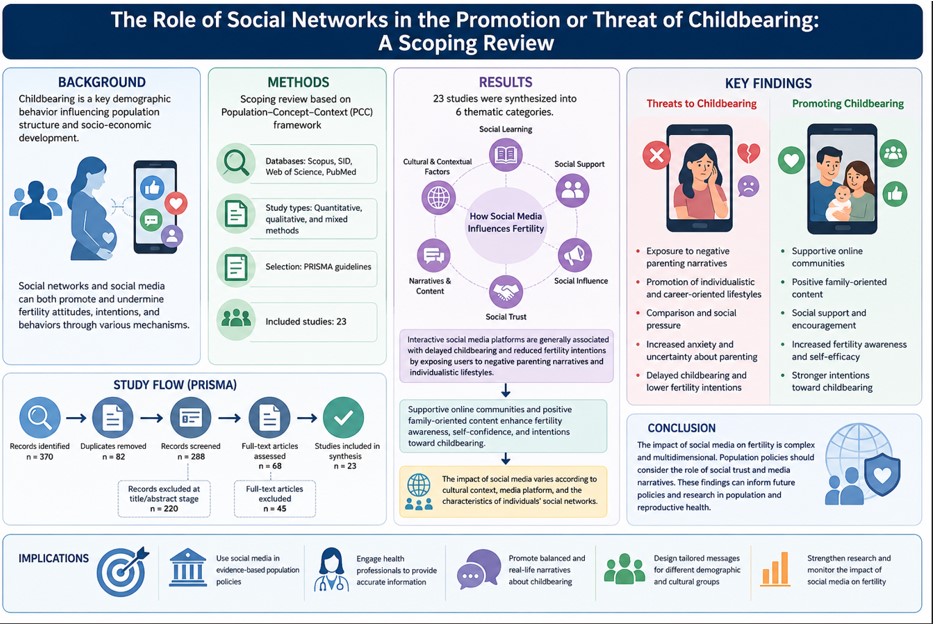
Background and purpose: as one of the most important demographic behaviours, plays a key role in shaping population structure and contributing to the socioeconomic development of societies. Social networks and social media, as modern platforms for social interaction, can both promote and discourage fertility attitudes, intentions, and behaviours through various mechanisms. Despite the growing number of studies in this field, the existing evidence remains fragmented and heterogeneous.
Materials and methods: This study was conducted as a scoping review based on the Population-Concept-Context (PCC) framework. A systematic search was performed in Scopus, the Scientific Information Database (SID), Web of Science, and PubMed. Quantitative, qualitative, and mixed-methods studies were included. The study selection process followed PRISMA guidelines, and 23 eligible studies were ultimately included in the thematic analysis.
Results: Twenty-three eligible studies were included and synthesized into six thematic categories. The findings indicated that social media influences fertility through mechanisms such as social learning, social support, social influence, and social trust. Interactive social media platforms were generally associated with delayed childbearing and reduced fertility intentions by exposing users to negative parenting narratives and individualistic lifestyles. In contrast, supportive online communities and positive family-oriented content were associated with greater fertility awareness, self-confidence, and intentions to have children. The evidence also suggested that the impact of social media varies according to cultural context, the type of media platform, and individual social-network characteristics.
Conclusion: This scoping review indicates that the impact of social media on fertility is complex and multidimensional, highlighting the need to consider the roles of social trust and media narratives in population policy. These findings may provide a basis for informing future policy development and research in the fields of population and reproductive health.
Materials and methods: This study was conducted as a scoping review based on the Population-Concept-Context (PCC) framework. A systematic search was performed in Scopus, the Scientific Information Database (SID), Web of Science, and PubMed. Quantitative, qualitative, and mixed-methods studies were included. The study selection process followed PRISMA guidelines, and 23 eligible studies were ultimately included in the thematic analysis.
Results: Twenty-three eligible studies were included and synthesized into six thematic categories. The findings indicated that social media influences fertility through mechanisms such as social learning, social support, social influence, and social trust. Interactive social media platforms were generally associated with delayed childbearing and reduced fertility intentions by exposing users to negative parenting narratives and individualistic lifestyles. In contrast, supportive online communities and positive family-oriented content were associated with greater fertility awareness, self-confidence, and intentions to have children. The evidence also suggested that the impact of social media varies according to cultural context, the type of media platform, and individual social-network characteristics.
Conclusion: This scoping review indicates that the impact of social media on fertility is complex and multidimensional, highlighting the need to consider the roles of social trust and media narratives in population policy. These findings may provide a basis for informing future policy development and research in the fields of population and reproductive health.
Keywords: childbearing, social networks, social media, fertility intentions, fertility-related attitudes, scoping review
Send email to the article author
| Rights and permissions | |
 |
This work is licensed under a Creative Commons Attribution-NonCommercial 4.0 International License. |

Articles Copyright © The Author(s). Owned by Mazandaran University of Medical Sciences.
Contact Us
Address: Journal Office, Building No. 2, Mazandaran University of Medical Sciences, Moallem Square, Sari.Tel: +98 (011)34484874 Postal code: 48175-866 E-Mail: jmums@mazums.ac.ir Telefax: +98 (011)33262679
