

Volume 36, Issue 260 (9-2026)
J Mazandaran Univ Med Sci 2026, 36(260): 199-211 |
Back to browse issues page



Download citation:
BibTeX | RIS | EndNote | Medlars | ProCite | Reference Manager | RefWorks
Send citation to:


BibTeX | RIS | EndNote | Medlars | ProCite | Reference Manager | RefWorks
Send citation to:
Imani M, Mahmoudi G, Jahani M, Yazdani-Charati J. Challenges and Influencing Factors in the Pharmaceutical Supply Chain for Patients with Rare Diseases: A Grounded Theory Study. J Mazandaran Univ Med Sci 2026; 36 (260) :199-211
URL: http://jmums.mazums.ac.ir/article-1-22998-en.html
URL: http://jmums.mazums.ac.ir/article-1-22998-en.html


Abstract: (18 Views)
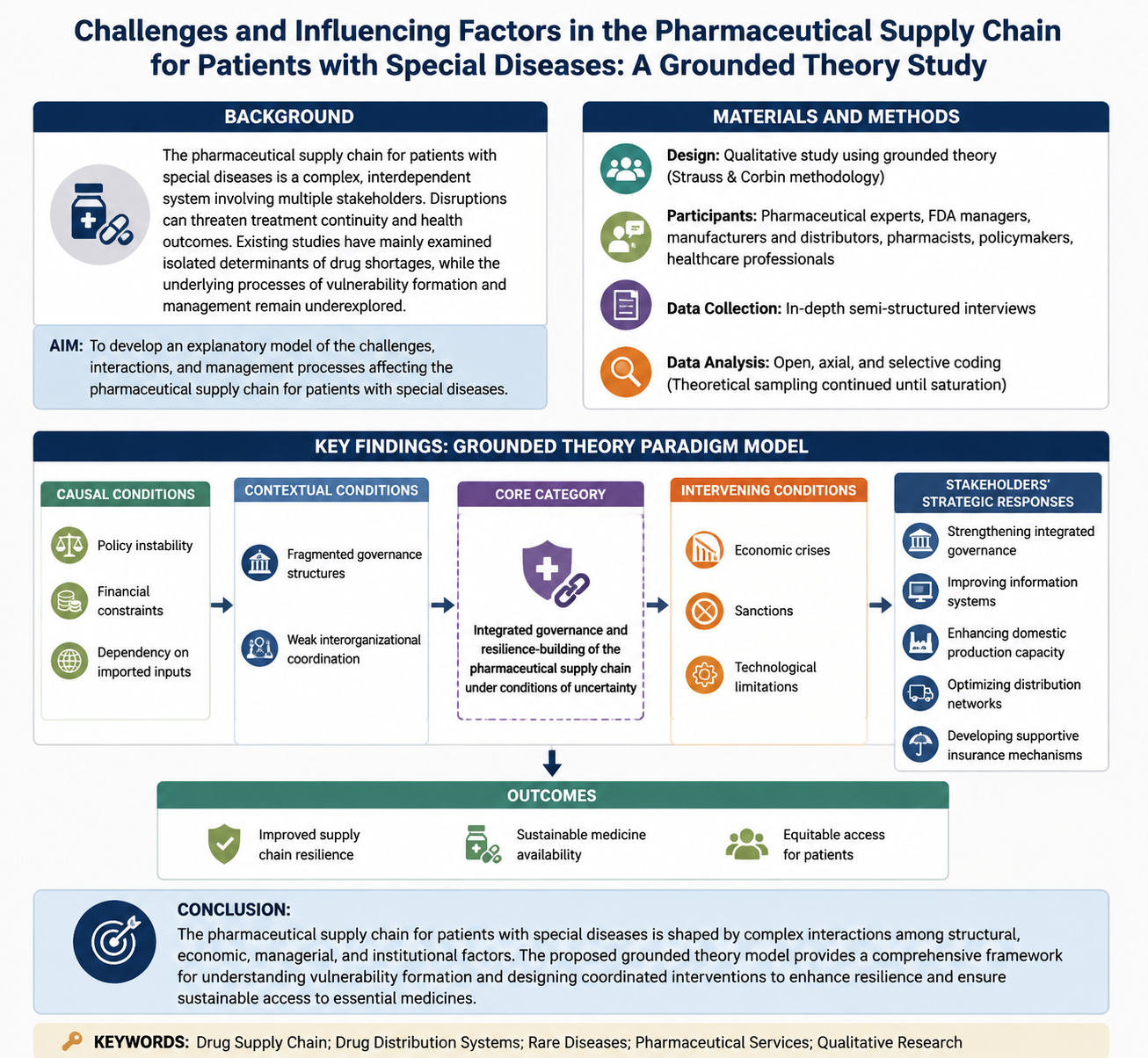
Background and purpose: The pharmaceutical supply chain serving patients with rare diseases is a complex and interdependent system requiring coordinated action among policymakers, manufacturers, distributors, insurers, and healthcare providers. Disruptions to the supply chain may compromise treatment continuity and patient outcomes. This study aimed to develop an explanatory model of the challenges, interactions, and management processes that shape the pharmaceutical supply chain for patients with rare diseases.
Materials and methods: This qualitative study used grounded theory based on the methodology developed by Strauss and Corbin. Participants included pharmaceutical experts, Food and Drug Administration managers, manufacturers, distributors, pharmacists, health policymakers, and healthcare professionals who were selected through purposive and theoretical sampling. Data were collected through semi-structured interviews and analyzed using open, axial, and selective coding until theoretical saturation was reached.
Results: The core category was identified as “integrated governance and resilience-building of the pharmaceutical supply chain under conditions of uncertainty.” The paradigm model indicated that supply chain vulnerability was shaped by causal conditions, including policy instability, financial constraints, and dependence on imported inputs; contextual conditions, including fragmented governance and weak interorganizational coordination; and intervening conditions, including economic crises, sanctions, and technological limitations. Key strategies included strengthening governance, improving information systems, enhancing domestic production, optimizing distribution networks, and developing supportive insurance mechanisms. These strategies contributed to greater supply chain resilience, sustained medicine availability, and more equitable access for patients.
Conclusion: The pharmaceutical supply chain for patients with rare diseases is shaped by complex structural, economic, managerial, and institutional interactions. The proposed model provides a comprehensive framework for understanding supply chain vulnerability and developing coordinated interventions to enhance resilience and ensure sustainable access to essential medicines.
Materials and methods: This qualitative study used grounded theory based on the methodology developed by Strauss and Corbin. Participants included pharmaceutical experts, Food and Drug Administration managers, manufacturers, distributors, pharmacists, health policymakers, and healthcare professionals who were selected through purposive and theoretical sampling. Data were collected through semi-structured interviews and analyzed using open, axial, and selective coding until theoretical saturation was reached.
Results: The core category was identified as “integrated governance and resilience-building of the pharmaceutical supply chain under conditions of uncertainty.” The paradigm model indicated that supply chain vulnerability was shaped by causal conditions, including policy instability, financial constraints, and dependence on imported inputs; contextual conditions, including fragmented governance and weak interorganizational coordination; and intervening conditions, including economic crises, sanctions, and technological limitations. Key strategies included strengthening governance, improving information systems, enhancing domestic production, optimizing distribution networks, and developing supportive insurance mechanisms. These strategies contributed to greater supply chain resilience, sustained medicine availability, and more equitable access for patients.
Conclusion: The pharmaceutical supply chain for patients with rare diseases is shaped by complex structural, economic, managerial, and institutional interactions. The proposed model provides a comprehensive framework for understanding supply chain vulnerability and developing coordinated interventions to enhance resilience and ensure sustainable access to essential medicines.
Keywords: drug supply chain, drug distribution systems, rare diseases, pharmaceutical services, qualitative research
Type of Study: Qualitative Research |
Subject:
Pharmacy
Send email to the article author
| Rights and permissions | |
 |
This work is licensed under a Creative Commons Attribution-NonCommercial 4.0 International License. |

Articles Copyright © The Author(s). Owned by Mazandaran University of Medical Sciences.
Contact Us
Address: Journal Office, Building No. 2, Mazandaran University of Medical Sciences, Moallem Square, Sari.Tel: +98 (011)34484874 Postal code: 48175-866 E-Mail: jmums@mazums.ac.ir Telefax: +98 (011)33262679
