

Volume 36, Issue 260 (9-2026)
J Mazandaran Univ Med Sci 2026, 36(260): 273-289 |
Back to browse issues page



Download citation:
BibTeX | RIS | EndNote | Medlars | ProCite | Reference Manager | RefWorks
Send citation to:


BibTeX | RIS | EndNote | Medlars | ProCite | Reference Manager | RefWorks
Send citation to:
Heidari N, Mohseni A, azizi S, Naghinezhad J. Platelets in Immunothrombosis and Thromboinflammation: Clinical and Therapeutic Perspectives. J Mazandaran Univ Med Sci 2026; 36 (260) :273-289
URL: http://jmums.mazums.ac.ir/article-1-23170-en.html
URL: http://jmums.mazums.ac.ir/article-1-23170-en.html


Abstract: (36 Views)
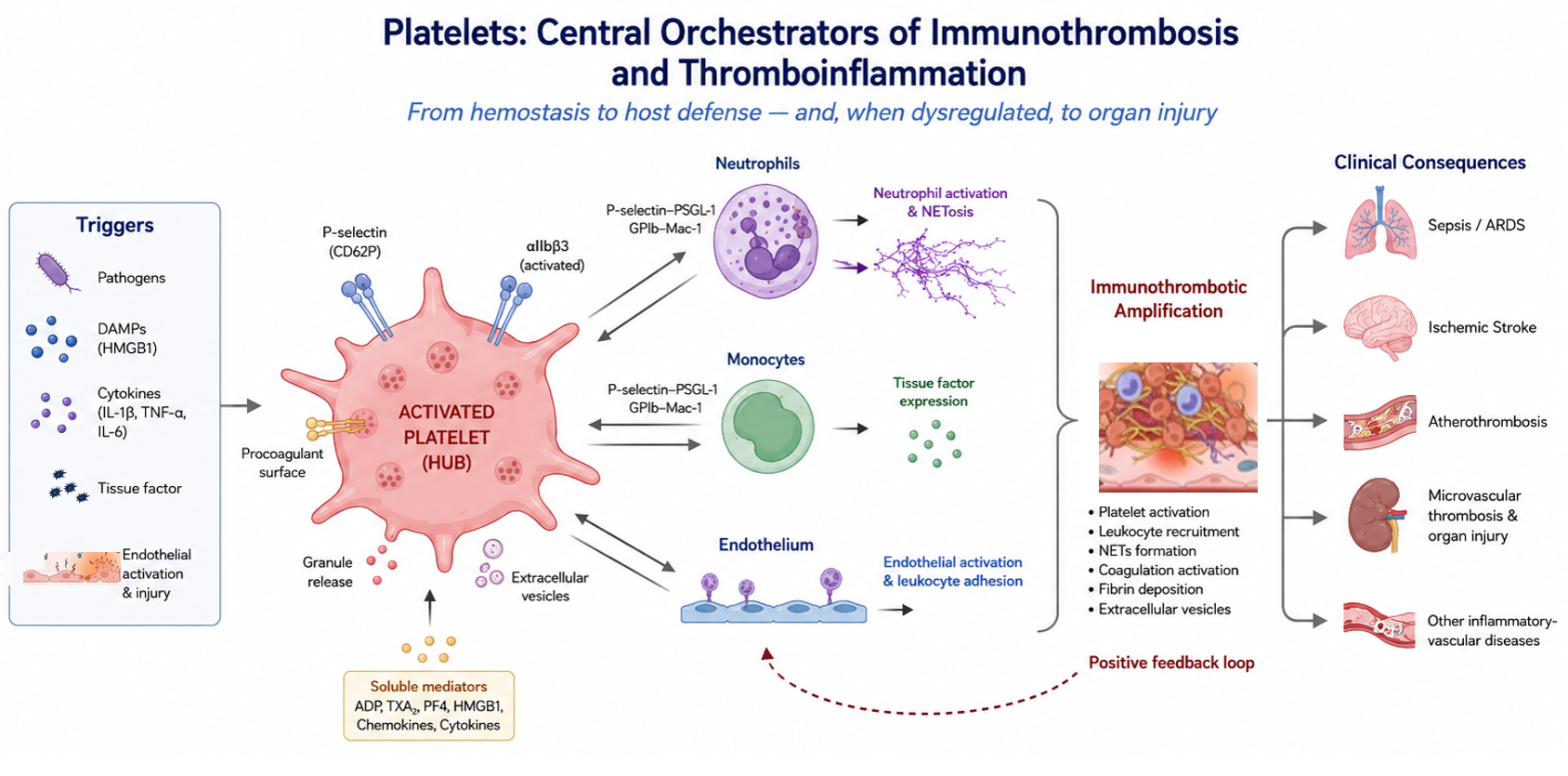
Background and purpose: In the classical view, platelets were regarded primarily as anucleate cellular fragments responsible for maintaining hemostasis and preventing blood loss. This restricted view has been fundamentally revised by growing evidence that platelets function as highly responsive immune and inflammatory effectors at the interface of coagulation, innate immunity, and vascular biology. In this context, immunothrombosis and thromboinflammation have emerged as key biological frameworks for understanding how platelet activation can simultaneously contribute to host defense and drive pathological vascular injury. Activated platelets interact dynamically with neutrophils, monocytes, endothelial cells, and other circulating or tissue-resident immune cells, promoting leukocyte recruitment, endothelial activation, tissue factor expression, and the formation of platelet–leukocyte aggregates. Importantly, platelet-derived signals can promote neutrophil extracellular trap (NET) formation, while NETs themselves provide a highly thrombogenic scaffold that amplifies platelet activation and coagulation, creating self-reinforcing inflammatory–thrombotic circuits. Platelets also release cytokines, chemokines, granule-derived mediators, and extracellular vesicles that can reshape local immune and vascular responses beyond the site of initial platelet activation. These mechanisms are increasingly implicated in the pathogenesis of sepsis, acute respiratory distress syndrome, ischemic stroke, atherosclerosis and atherothrombosis, and other inflammatory and vascular disorders. From a clinical perspective, the expanding recognition of platelet–immune interactions provides a framework for interpreting platelet activation not simply as a consequence of vascular injury, but as a potential driver and biomarker of disease progression. This review examines the molecular and cellular mechanisms through which platelets orchestrate immunothrombosis and thromboinflammation, with particular emphasis on platelet–leukocyte crosstalk, NETosis, endothelial dysfunction, and extracellular vesicle signaling. Finally, we discuss emerging diagnostic and therapeutic strategies aimed at selectively disrupting pathological platelet–immune circuits while preserving essential hemostatic functions, highlighting opportunities for more precise interventions in thromboinflammatory disease.
Keywords: platelets, immunothrombosis, thromboinflammation, sepsis, neutrophil extracellular traps, HMGB1, extracellular vesicles
Type of Study: Review |
Subject:
Hematology and Oncology
Send email to the article author
| Rights and permissions | |
 |
This work is licensed under a Creative Commons Attribution-NonCommercial 4.0 International License. |

Articles Copyright © The Author(s). Owned by Mazandaran University of Medical Sciences.
Contact Us
Address: Journal Office, Building No. 2, Mazandaran University of Medical Sciences, Moallem Square, Sari.Tel: +98 (011)34484874 Postal code: 48175-866 E-Mail: jmums@mazums.ac.ir Telefax: +98 (011)33262679
