

Volume 36, Issue 258 (7-2026)
J Mazandaran Univ Med Sci 2026, 36(258): 113-118 |
Back to browse issues page



Download citation:
BibTeX | RIS | EndNote | Medlars | ProCite | Reference Manager | RefWorks
Send citation to:


BibTeX | RIS | EndNote | Medlars | ProCite | Reference Manager | RefWorks
Send citation to:
Mohammadi M, Omran S M, Jafarzadeh J, Kiakojuri K, Armaki M T, Aminian A R. Genotyping of Aspergillus flavus Isolates from Patients with Otomycosis in Babol Using Multiple-Locus Variable Number Tandem-Repeat Analysis (MLVA). J Mazandaran Univ Med Sci 2026; 36 (258) :113-118
URL: http://jmums.mazums.ac.ir/article-1-21664-en.html
URL: http://jmums.mazums.ac.ir/article-1-21664-en.html
Masoumeh Mohammadi 
 , Saeid Mahdavi Omran , Jalal Jafarzadeh , Keyvan Kiakojuri , Mojtaba Taghizadeh Armaki , Ahmad Reza Aminian
, Saeid Mahdavi Omran , Jalal Jafarzadeh , Keyvan Kiakojuri , Mojtaba Taghizadeh Armaki , Ahmad Reza Aminian
Abstract: (553 Views)
Background and purpose: After Aspergillus fumigatus, A. flavus is the second most common cause of invasive and non-invasive aspergillosis. Otomycosis is a superficial fungal infection of the external auditory canal, with a worldwide incidence ranging from 9% to 30%. Most cases of otomycosis are caused by Aspergillus species. The aim of the present study was to genotype A. flavus strains isolated from patients with otomycosis in Babol using the Multiple-Locus Variable Number Tandem-Repeat Analysis (MLVA) molecular technique.
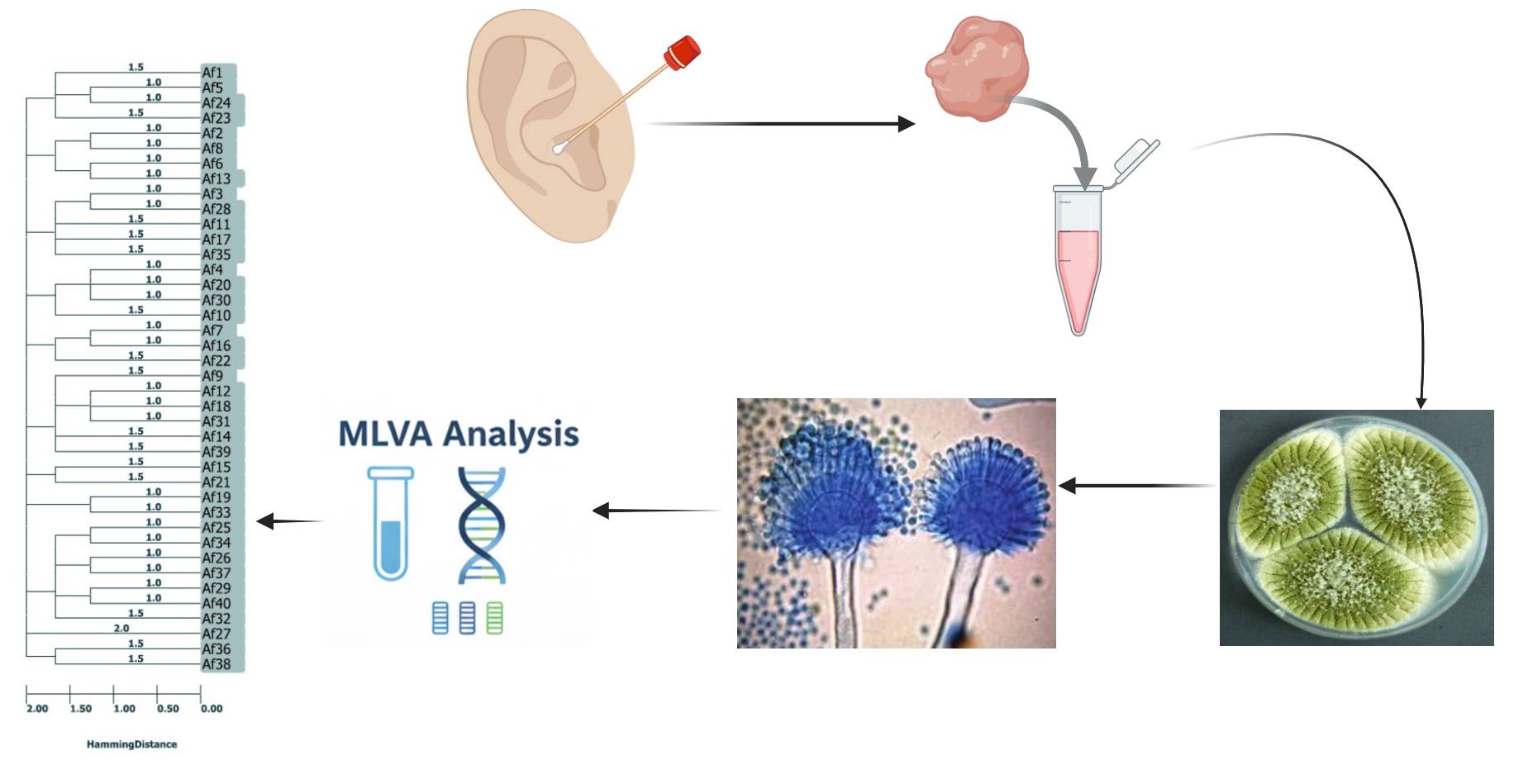
Materials and methods: In this descriptive cross-sectional study, ear samples were collected by an Ear, Nose and Throat (ENT) specialist using sterile swabs over a five-year period. The samples were then transferred to the mycology laboratory under sterile conditions for direct microscopic examination using 10% KOH and culture on Sabouraud dextrose agar. A total of 40 A. flavus isolates were collected from patients with otomycosis. After DNA extraction, MLVA was performed using four variable number tandem repeat (VNTR) markers for A. flavus (AFLA1, AFLA3, AFLA7, and AFMP3) to determine the genetic diversity and potential relatedness of the clinical isolates by polymerase chain reaction (PCR).
Results: Microsatellite typing of the 40 A. flavus isolates identified 40 distinct genotypes (sequence types). The Simpson's index of diversity for the markers ranged from 0.895 to 0.940. No two isolates exhibited 100% genetic similarity. Among the four markers, AFLA1 demonstrated the highest discriminatory power.
Conclusion: Microsatellite genotyping revealed considerable genetic diversity among A. flavus isolates obtained from patients with otomycosis. Furthermore, there was no evidence of an association between a specific genotype and the clinical presentation of A. flavus otomycosis.
Materials and methods: In this descriptive cross-sectional study, ear samples were collected by an Ear, Nose and Throat (ENT) specialist using sterile swabs over a five-year period. The samples were then transferred to the mycology laboratory under sterile conditions for direct microscopic examination using 10% KOH and culture on Sabouraud dextrose agar. A total of 40 A. flavus isolates were collected from patients with otomycosis. After DNA extraction, MLVA was performed using four variable number tandem repeat (VNTR) markers for A. flavus (AFLA1, AFLA3, AFLA7, and AFMP3) to determine the genetic diversity and potential relatedness of the clinical isolates by polymerase chain reaction (PCR).
Results: Microsatellite typing of the 40 A. flavus isolates identified 40 distinct genotypes (sequence types). The Simpson's index of diversity for the markers ranged from 0.895 to 0.940. No two isolates exhibited 100% genetic similarity. Among the four markers, AFLA1 demonstrated the highest discriminatory power.
Conclusion: Microsatellite genotyping revealed considerable genetic diversity among A. flavus isolates obtained from patients with otomycosis. Furthermore, there was no evidence of an association between a specific genotype and the clinical presentation of A. flavus otomycosis.
Type of Study: Brief Report |
Subject:
mycology
Send email to the article author
| Rights and permissions | |
 |
This work is licensed under a Creative Commons Attribution-NonCommercial 4.0 International License. |

Articles Copyright © The Author(s). Owned by Mazandaran University of Medical Sciences.
Contact Us
Address: Journal Office, Building No. 2, Mazandaran University of Medical Sciences, Moallem Square, Sari.Tel: +98 (011)34484874 Postal code: 48175-866 E-Mail: jmums@mazums.ac.ir Telefax: +98 (011)33262679
