

Volume 36, Issue 258 (7-2026)
J Mazandaran Univ Med Sci 2026, 36(258): 77-85 |
Back to browse issues page



Download citation:
BibTeX | RIS | EndNote | Medlars | ProCite | Reference Manager | RefWorks
Send citation to:


BibTeX | RIS | EndNote | Medlars | ProCite | Reference Manager | RefWorks
Send citation to:
Khezeli F, Talebi S S, Shiri E, Zarei M, Ramezani-Aliakbari F. Silymarin Attenuates Isoprenaline-Induced Cardiac Hypertrophy in Rats: A Possible Role for Beclin 1. J Mazandaran Univ Med Sci 2026; 36 (258) :77-85
URL: http://jmums.mazums.ac.ir/article-1-22583-en.html
URL: http://jmums.mazums.ac.ir/article-1-22583-en.html


Abstract: (581 Views)
Background and purpose: Cardiac hypertrophy is a major risk factor for heart failure. Autophagy is a dynamic catabolic process that is essential for maintaining cellular homeostasis. It plays an important role in isoprenaline-induced cardiac hypertrophy. Silymarin has demonstrated cardioprotective effects against various cardiac diseases. The present study aimed to investigate the effects of silymarin on cardiac hypertrophy through the regulation of Beclin 1 gene expression in rats treated with isoprenaline.
Materials and methods: In this experimental study, 20 male Wistar rats aged 2.5 months and weighing 250-300 g were included in this study. The rats were randomly divided into four groups: control (CONT), silymarin control (CONT + SLY), isoprenaline (ISO), and isoprenaline plus silymarin (ISO + SLY). To induce cardiac hypertrophy, animals received subcutaneous injections of isoprenaline (5 mg/kg) for 10 consecutive days. Four days prior to isoprenaline administration, rats were treated with silymarin (50 mg/kg) by oral gavage for 14 days. Cardiac histological analysis was performed, and the hypertrophy index, serum lactate dehydrogenase levels, and molecular parameters were assessed. Differences between groups were analysed using one-way analysis of variance (ANOVA) followed by Tukey’s post hoc test in SPSS software.
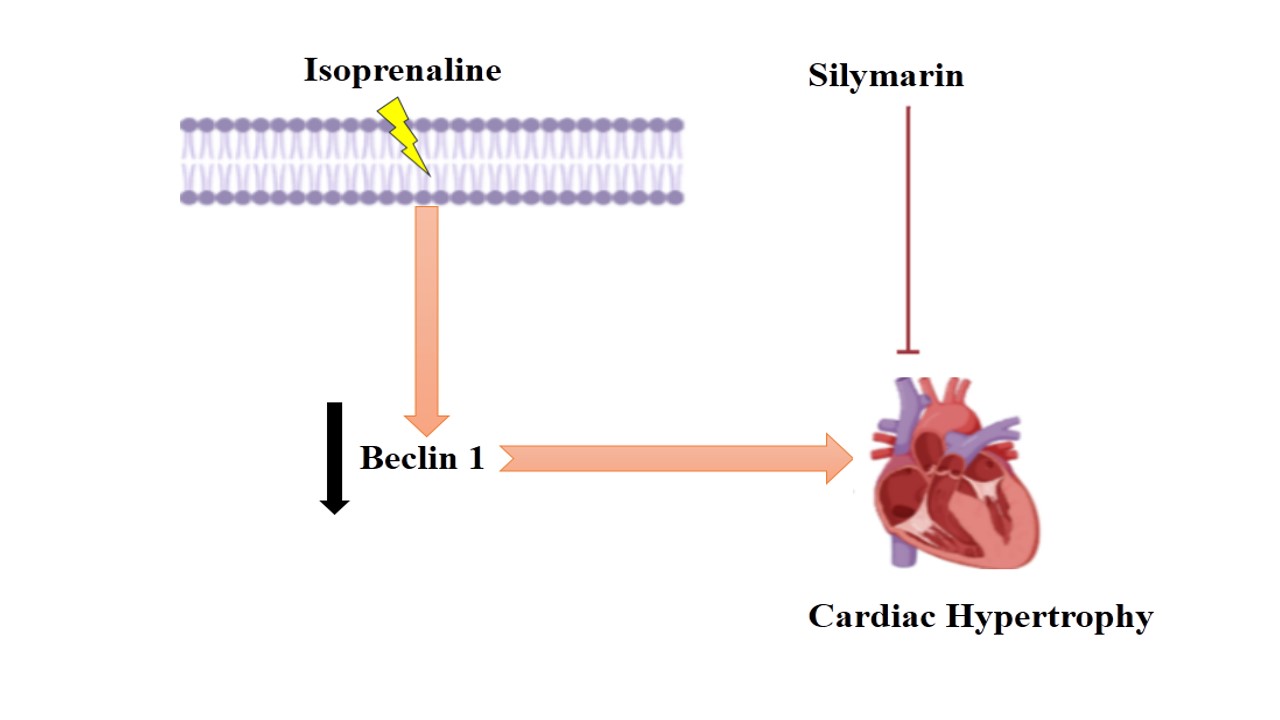
Results: Isoprenaline administration induced cardiac hypertrophy, increased serum lactate dehydrogenase levels, and decreased Beclin 1 gene expression in cardiac tissue compared with the control group. Silymarin treatment attenuated cardiac hypertrophy and restored Beclin 1 gene expression. However, silymarin treatment did not significantly affect lactate dehydrogenase levels.
Conclusion: Silymarin exerts a protective effect against isoprenaline-induced cardiac hypertrophy, and this effect may be mediated, at least in part, by upregulation of Beclin 1 gene expression in cardiac tissue.
Materials and methods: In this experimental study, 20 male Wistar rats aged 2.5 months and weighing 250-300 g were included in this study. The rats were randomly divided into four groups: control (CONT), silymarin control (CONT + SLY), isoprenaline (ISO), and isoprenaline plus silymarin (ISO + SLY). To induce cardiac hypertrophy, animals received subcutaneous injections of isoprenaline (5 mg/kg) for 10 consecutive days. Four days prior to isoprenaline administration, rats were treated with silymarin (50 mg/kg) by oral gavage for 14 days. Cardiac histological analysis was performed, and the hypertrophy index, serum lactate dehydrogenase levels, and molecular parameters were assessed. Differences between groups were analysed using one-way analysis of variance (ANOVA) followed by Tukey’s post hoc test in SPSS software.
Results: Isoprenaline administration induced cardiac hypertrophy, increased serum lactate dehydrogenase levels, and decreased Beclin 1 gene expression in cardiac tissue compared with the control group. Silymarin treatment attenuated cardiac hypertrophy and restored Beclin 1 gene expression. However, silymarin treatment did not significantly affect lactate dehydrogenase levels.
Conclusion: Silymarin exerts a protective effect against isoprenaline-induced cardiac hypertrophy, and this effect may be mediated, at least in part, by upregulation of Beclin 1 gene expression in cardiac tissue.
Type of Study: Research(Original) |
Subject:
physiology
Send email to the article author
| Rights and permissions | |
 |
This work is licensed under a Creative Commons Attribution-NonCommercial 4.0 International License. |

Articles Copyright © The Author(s). Owned by Mazandaran University of Medical Sciences.
Contact Us
Address: Journal Office, Building No. 2, Mazandaran University of Medical Sciences, Moallem Square, Sari.Tel: +98 (011)34484874 Postal code: 48175-866 E-Mail: jmums@mazums.ac.ir Telefax: +98 (011)33262679
