

Volume 36, Issue 261 (10-2026)
J Mazandaran Univ Med Sci 2026, 36(261): 166-177 |
Back to browse issues page



Download citation:
BibTeX | RIS | EndNote | Medlars | ProCite | Reference Manager | RefWorks
Send citation to:


BibTeX | RIS | EndNote | Medlars | ProCite | Reference Manager | RefWorks
Send citation to:
Yazdani Charati J, Alinasab Z, Soltani S A. Challenges and Opportunities for Generation Z Students in Medical Education: A Systematic Review and Qualitative Evidence Synthesis. J Mazandaran Univ Med Sci 2026; 36 (261) :166-177
URL: http://jmums.mazums.ac.ir/article-1-22780-en.html
URL: http://jmums.mazums.ac.ir/article-1-22780-en.html


Abstract: (19 Views)
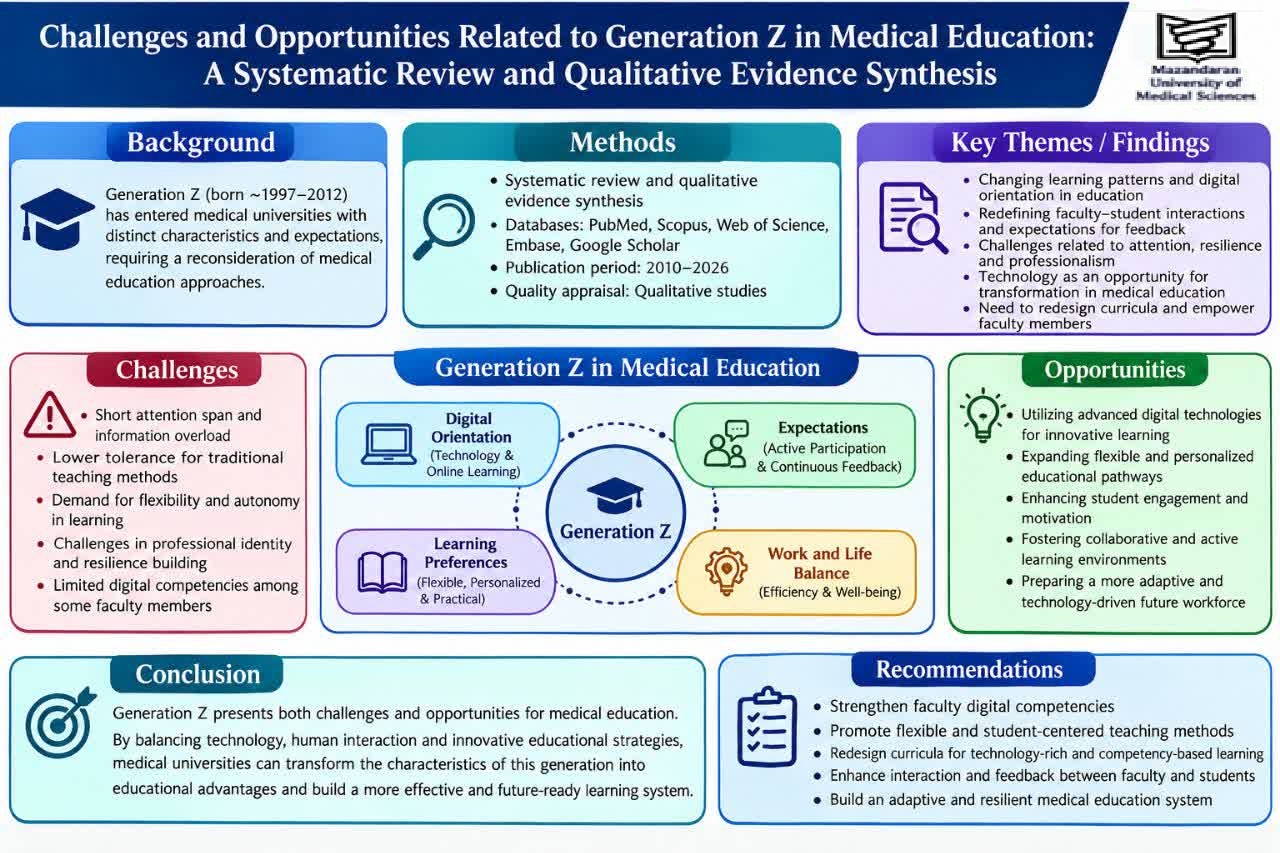
Background and purpose: Demographic changes and the emergence of a new generation of students in medical universities have increased the need to reconsider approaches to medical education. Generation Z, characterized by extensive engagement with digital technology, a preference for flexible learning, and expectations of active participation in the educational process, has needs and expectations that may differ from those of previous generations. This study aimed to identify and synthesize the available evidence on the challenges and opportunities associated with Generation Z students in medical education.
Materials and methods: This systematic review and qualitative evidence synthesis was conducted through systematic searches of PubMed, Scopus, Web of Science, Embase, and Google Scholar for studies published between 2010 and 2026. Studies addressing the experiences, perspectives, challenges, and opportunities associated with medical education among Generation Z students were considered. Following screening of titles, abstracts, and full texts, eligible studies were included in the review. Data were extracted and synthesized using thematic analysis, and the methodological quality of qualitative studies was assessed using an appropriate critical appraisal tool.
Results: The findings were categorized into five main themes: changes in learning patterns and the shift towards digitally oriented education; redefining faculty-student interactions and expectations of continuous feedback; challenges related to attention, resilience, and professionalism; technology as an opportunity for transforming medical education; and the need to redesign curricula and strengthen faculty capacity. Although some characteristics of Generation Z may pose challenges within traditional educational frameworks, the evidence suggests that adapting educational structures may transform these characteristics into opportunities to enhance the quality of learning.
Conclusion: An appropriate response to the characteristics of Generation Z requires a balance between leveraging technology, maintaining human interaction, and redesigning educational approaches. Strengthening faculty members' digital competencies, promoting flexible teaching methods, and revising curricula can provide a foundation for medical education that is responsive to the needs of Generation Z.
Materials and methods: This systematic review and qualitative evidence synthesis was conducted through systematic searches of PubMed, Scopus, Web of Science, Embase, and Google Scholar for studies published between 2010 and 2026. Studies addressing the experiences, perspectives, challenges, and opportunities associated with medical education among Generation Z students were considered. Following screening of titles, abstracts, and full texts, eligible studies were included in the review. Data were extracted and synthesized using thematic analysis, and the methodological quality of qualitative studies was assessed using an appropriate critical appraisal tool.
Results: The findings were categorized into five main themes: changes in learning patterns and the shift towards digitally oriented education; redefining faculty-student interactions and expectations of continuous feedback; challenges related to attention, resilience, and professionalism; technology as an opportunity for transforming medical education; and the need to redesign curricula and strengthen faculty capacity. Although some characteristics of Generation Z may pose challenges within traditional educational frameworks, the evidence suggests that adapting educational structures may transform these characteristics into opportunities to enhance the quality of learning.
Conclusion: An appropriate response to the characteristics of Generation Z requires a balance between leveraging technology, maintaining human interaction, and redesigning educational approaches. Strengthening faculty members' digital competencies, promoting flexible teaching methods, and revising curricula can provide a foundation for medical education that is responsive to the needs of Generation Z.
Type of Study: Review |
Subject:
medical education
Send email to the article author
| Rights and permissions | |
 |
This work is licensed under a Creative Commons Attribution-NonCommercial 4.0 International License. |

Articles Copyright © The Author(s). Owned by Mazandaran University of Medical Sciences.
Contact Us
Address: Journal Office, Building No. 2, Mazandaran University of Medical Sciences, Moallem Square, Sari.Tel: +98 (011)34484874 Postal code: 48175-866 E-Mail: jmums@mazums.ac.ir Telefax: +98 (011)33262679
