

Volume 36, Issue 259 (8-2026)
J Mazandaran Univ Med Sci 2026, 36(259): 204-217 |
Back to browse issues page



Download citation:
BibTeX | RIS | EndNote | Medlars | ProCite | Reference Manager | RefWorks
Send citation to:


BibTeX | RIS | EndNote | Medlars | ProCite | Reference Manager | RefWorks
Send citation to:
Rezazadeh F, Aali S, Nabati Sefidehkhan M. Urinary Incontinence Rehabilitation Using a Motor Control Approach with an Emphasis on Motor System Integrity: A Systematic Review. J Mazandaran Univ Med Sci 2026; 36 (259) :204-217
URL: http://jmums.mazums.ac.ir/article-1-22885-en.html
URL: http://jmums.mazums.ac.ir/article-1-22885-en.html


Abstract: (624 Views)
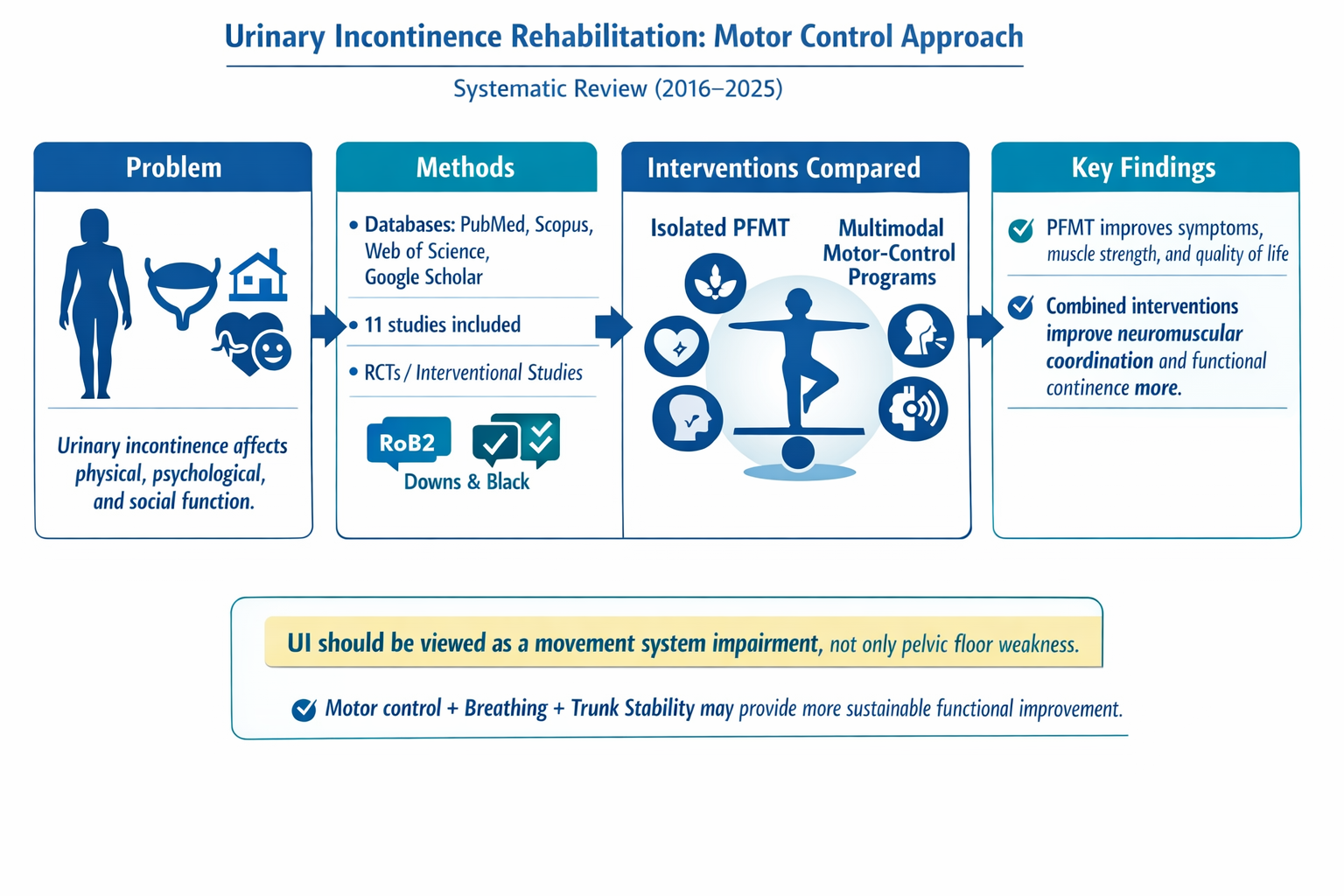
Background and purpose: Urinary incontinence (UI) is a prevalent condition among women and is associated with considerable physical, psychological, and social consequences. This systematic review aimed to synthesize the current evidence on the biomechanical and motor control mechanisms involved in UI rehabilitation and evaluate the effectiveness of integrated therapeutic approaches
Materials and methods: A systematic review was conducted in accordance with the PRISMA 2020 guidelines. PubMed, Scopus, Web of Science, and Google Scholar were searched for studies published between 2016 and 2025. Eligibility criteria were defined using the PICOS framework and included randomized controlled trials and interventional studies involving women with urinary incontinence. Methodological quality was assessed using the modified Downs and Black checklist, and risk of bias was evaluated using the RoB2 tool. Due to the heterogeneity of interventions and outcomes, findings were synthesized narratively following the SWiM framework.
Results: Eleven studies met the inclusion criteria. PFMT significantly reduced UI severity and improved pelvic floor muscle strength and quality of life. However, multidimensional interventions incorporating diaphragmatic breathing exercises, postural control training, and biofeedback demonstrated greater improvements in neuromuscular coordination and functional continence outcomes. Most included studies were of moderate to good methodological quality and generally had a low to moderate risk of bias. Overall, the findings support the role of combined interventions in improving functional control rather than merely increasing muscle strength.
Conclusion: UI should be viewed as a movement system impairment rather than simply an isolated pelvic floor weakness. Multimodal interventions targeting motor control, respiratory coordination, and trunk stability may lead to more sustainable functional improvements than isolated strengthening approaches.
Materials and methods: A systematic review was conducted in accordance with the PRISMA 2020 guidelines. PubMed, Scopus, Web of Science, and Google Scholar were searched for studies published between 2016 and 2025. Eligibility criteria were defined using the PICOS framework and included randomized controlled trials and interventional studies involving women with urinary incontinence. Methodological quality was assessed using the modified Downs and Black checklist, and risk of bias was evaluated using the RoB2 tool. Due to the heterogeneity of interventions and outcomes, findings were synthesized narratively following the SWiM framework.
Results: Eleven studies met the inclusion criteria. PFMT significantly reduced UI severity and improved pelvic floor muscle strength and quality of life. However, multidimensional interventions incorporating diaphragmatic breathing exercises, postural control training, and biofeedback demonstrated greater improvements in neuromuscular coordination and functional continence outcomes. Most included studies were of moderate to good methodological quality and generally had a low to moderate risk of bias. Overall, the findings support the role of combined interventions in improving functional control rather than merely increasing muscle strength.
Conclusion: UI should be viewed as a movement system impairment rather than simply an isolated pelvic floor weakness. Multimodal interventions targeting motor control, respiratory coordination, and trunk stability may lead to more sustainable functional improvements than isolated strengthening approaches.
Keywords: urinary incontinence, pelvic floor muscle dysfunction, movement system impairment, motor control, pelvic floor biomechanics
Type of Study: Review |
Subject:
Sports biomechanics
Send email to the article author
| Rights and permissions | |
 |
This work is licensed under a Creative Commons Attribution-NonCommercial 4.0 International License. |

Articles Copyright © The Author(s). Owned by Mazandaran University of Medical Sciences.
Contact Us
Address: Journal Office, Building No. 2, Mazandaran University of Medical Sciences, Moallem Square, Sari.Tel: +98 (011)34484874 Postal code: 48175-866 E-Mail: jmums@mazums.ac.ir Telefax: +98 (011)33262679
