

Volume 36, Issue 261 (10-2026)
J Mazandaran Univ Med Sci 2026, 36(261): 6-17 |
Back to browse issues page



Download citation:
BibTeX | RIS | EndNote | Medlars | ProCite | Reference Manager | RefWorks
Send citation to:


BibTeX | RIS | EndNote | Medlars | ProCite | Reference Manager | RefWorks
Send citation to:
Shams M, Eskandari T, Malekian M, Dehghan N, Jalali H, karami H, et al . Frequency and Levels of Autoantibodies Among Women of Reproductive Age with Beta-Thalassemia Major: A Case-Control Study. J Mazandaran Univ Med Sci 2026; 36 (261) :6-17
URL: http://jmums.mazums.ac.ir/article-1-22917-en.html
URL: http://jmums.mazums.ac.ir/article-1-22917-en.html
Mehrshad Shams 
 , Tamana Eskandari , Mohammad Malekian , Nilofar Dehghan , Hossein Jalali , Hossein Karami , Mohammad Naderisoraki , Hadi DarvishKhezri , Hossein Asgarian-Omran , Mohsen Tehrani , Saeid Taghiloo
, Tamana Eskandari , Mohammad Malekian , Nilofar Dehghan , Hossein Jalali , Hossein Karami , Mohammad Naderisoraki , Hadi DarvishKhezri , Hossein Asgarian-Omran , Mohsen Tehrani , Saeid Taghiloo
Abstract: (19 Views)
Background and purpose: Beta-thalassemia is an inherited haematological disorder, and patients may experience alterations and dysregulation of immune responses as a result of regular blood transfusions and iron overload. Autoantibodies have been associated with autoimmune disorders and adverse pregnancy outcomes in some studies. Given the importance of evaluating the immune status of women of reproductive age with beta-thalassemia major, this study aimed to compare the levels and prevalence of positivity of selected autoantibodies between women with beta-thalassemia major and healthy women.
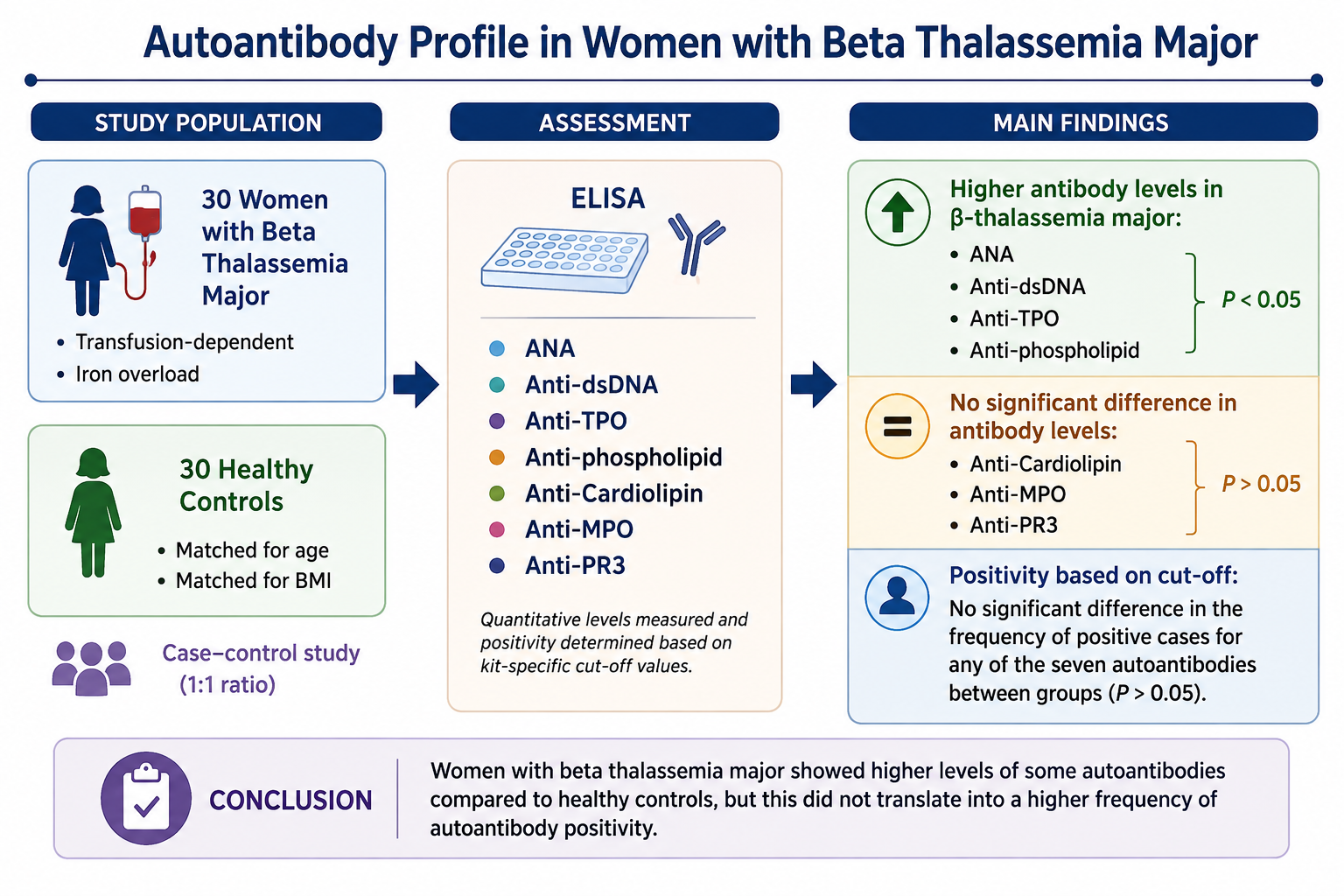
Materials and methods: his case-control study included 30 women with beta-thalassemia major and 30 healthy women matched by age and body mass index. Autoantibody levels were measured using ELISA, according to the manufacturers’ instructions for the respective commercial kits. In addition to comparing quantitative autoantibody levels, participants were classified as positive or negative based on the assay-specific cut-off values, and the frequencies of positive cases were compared between the two groups.
Results: The mean levels of ANA, anti-dsDNA, anti-TPO, and anti-phospholipid antibodies were significantly higher in the beta-thalassemia major group than in the control group (P<0.05), whereas no significant differences were observed in the levels of anti-cardiolipin, anti-MPO, or anti-PR3 antibodies (P> 0.05). However, based on the assay-specific cut-off values, no significant differences were observed in the proportion of participants testing positive for any of the seven autoantibodies between the two groups (P> 0.05).
Conclusion: Women with beta-thalassemia major exhibited higher quantitative levels of several autoantibodies than healthy controls, although these differences were not accompanied by a significant increase in the proportion of participants testing positive according to the assay-specific cut-off values. Nevertheless, the findings highlight the potential value of further investigating autoantibody status as part of preconception assessment in women with beta-thalassemia major.
Materials and methods: his case-control study included 30 women with beta-thalassemia major and 30 healthy women matched by age and body mass index. Autoantibody levels were measured using ELISA, according to the manufacturers’ instructions for the respective commercial kits. In addition to comparing quantitative autoantibody levels, participants were classified as positive or negative based on the assay-specific cut-off values, and the frequencies of positive cases were compared between the two groups.
Results: The mean levels of ANA, anti-dsDNA, anti-TPO, and anti-phospholipid antibodies were significantly higher in the beta-thalassemia major group than in the control group (P<0.05), whereas no significant differences were observed in the levels of anti-cardiolipin, anti-MPO, or anti-PR3 antibodies (P> 0.05). However, based on the assay-specific cut-off values, no significant differences were observed in the proportion of participants testing positive for any of the seven autoantibodies between the two groups (P> 0.05).
Conclusion: Women with beta-thalassemia major exhibited higher quantitative levels of several autoantibodies than healthy controls, although these differences were not accompanied by a significant increase in the proportion of participants testing positive according to the assay-specific cut-off values. Nevertheless, the findings highlight the potential value of further investigating autoantibody status as part of preconception assessment in women with beta-thalassemia major.
Type of Study: Research(Original) |
Subject:
Immunology
Send email to the article author
| Rights and permissions | |
 |
This work is licensed under a Creative Commons Attribution-NonCommercial 4.0 International License. |

Articles Copyright © The Author(s). Owned by Mazandaran University of Medical Sciences.
Contact Us
Address: Journal Office, Building No. 2, Mazandaran University of Medical Sciences, Moallem Square, Sari.Tel: +98 (011)34484874 Postal code: 48175-866 E-Mail: jmums@mazums.ac.ir Telefax: +98 (011)33262679
