

Volume 36, Issue 261 (10-2026)
J Mazandaran Univ Med Sci 2026, 36(261): 227-246 |
Back to browse issues page


Download citation:
BibTeX | RIS | EndNote | Medlars | ProCite | Reference Manager | RefWorks
Send citation to:


BibTeX | RIS | EndNote | Medlars | ProCite | Reference Manager | RefWorks
Send citation to:
Khanmohammadi R, Qanbari S, Bahadorani N. Effect of Transcranial Direct Current Stimulation on Balance in Individuals with Stroke: A Systematic Review
and Meta-Analysis. J Mazandaran Univ Med Sci 2026; 36 (261) :227-246
URL: http://jmums.mazums.ac.ir/article-1-22931-en.html
URL: http://jmums.mazums.ac.ir/article-1-22931-en.html


Abstract: (16 Views)
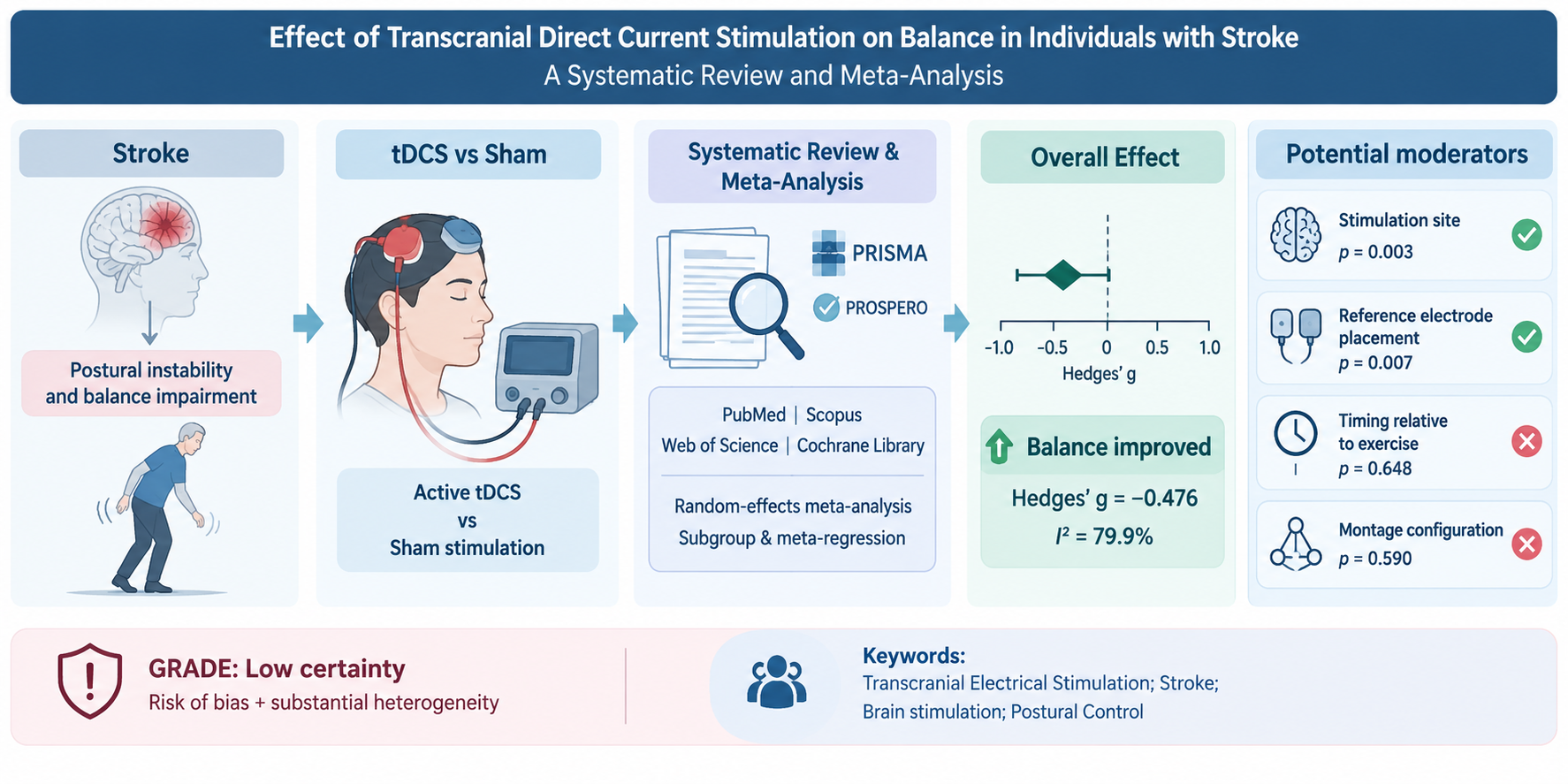
Background and purpose: Postural instability is a disabling consequence of stroke. Transcranial direct current stimulation (tDCS) has been proposed as an adjunctive intervention for rehabilitation; however, the efficacy of different stimulation parameters remains unclear. This study aimed to investigate the effect of tDCS on balance after stroke and identify its potential moderators.
Materials and methods: This systematic review and meta-analysis was conducted in accordance with the PRISMA guidelines and registered in PROSPERO. PubMed, Scopus, Web of Science, and Cochrane were searched from inception to February 25, 2025. Randomized controlled trials comparing active tDCS with sham stimulation in adults with stroke and reporting balance outcomes were included. A random-effects meta-analysis, subgroup analyses, and meta-regression were performed to investigate the treatment effect and its potential moderators. Risk of bias, publication bias, and certainty of evidence were assessed using the GRADE framework.
Results: Compared with sham stimulation, tDCS significantly improved balance (g = −0.476), although substantial heterogeneity was observed across studies (I² = 79.9%). The timing of tDCS relative to exercise did not significantly moderate the treatment effect (P = 0.648). Stimulation site (P = 0.003) and reference electrode (P = 0.007) were significant moderators of the treatment effect, whereas montage configuration was not (P = 0.590). Meta-regression showed that age, sex, stimulation parameters, exercise duration, and study quality were not significant moderators of the tDCS effect.
Conclusion: tDCS was associated with improved balance performance compared with sham stimulation; however, the certainty of evidence was rated as low due to risk of bias and heterogeneity. Although stimulation site and reference electrode moderated the treatment effect, these findings, particularly those from limited subgroups, should be interpreted cautiously. No evidence indicated that treatment effects were moderated by tDCS timing or montage configuration. Further well-designed studies with standardized protocols are needed to clarify the role of tDCS parameters in improving balance after stroke.
Materials and methods: This systematic review and meta-analysis was conducted in accordance with the PRISMA guidelines and registered in PROSPERO. PubMed, Scopus, Web of Science, and Cochrane were searched from inception to February 25, 2025. Randomized controlled trials comparing active tDCS with sham stimulation in adults with stroke and reporting balance outcomes were included. A random-effects meta-analysis, subgroup analyses, and meta-regression were performed to investigate the treatment effect and its potential moderators. Risk of bias, publication bias, and certainty of evidence were assessed using the GRADE framework.
Results: Compared with sham stimulation, tDCS significantly improved balance (g = −0.476), although substantial heterogeneity was observed across studies (I² = 79.9%). The timing of tDCS relative to exercise did not significantly moderate the treatment effect (P = 0.648). Stimulation site (P = 0.003) and reference electrode (P = 0.007) were significant moderators of the treatment effect, whereas montage configuration was not (P = 0.590). Meta-regression showed that age, sex, stimulation parameters, exercise duration, and study quality were not significant moderators of the tDCS effect.
Conclusion: tDCS was associated with improved balance performance compared with sham stimulation; however, the certainty of evidence was rated as low due to risk of bias and heterogeneity. Although stimulation site and reference electrode moderated the treatment effect, these findings, particularly those from limited subgroups, should be interpreted cautiously. No evidence indicated that treatment effects were moderated by tDCS timing or montage configuration. Further well-designed studies with standardized protocols are needed to clarify the role of tDCS parameters in improving balance after stroke.
Type of Study: Review |
Subject:
Physiotherapy
Send email to the article author
| Rights and permissions | |
 |
This work is licensed under a Creative Commons Attribution-NonCommercial 4.0 International License. |

Articles Copyright © The Author(s). Owned by Mazandaran University of Medical Sciences.
Contact Us
Address: Journal Office, Building No. 2, Mazandaran University of Medical Sciences, Moallem Square, Sari.Tel: +98 (011)34484874 Postal code: 48175-866 E-Mail: jmums@mazums.ac.ir Telefax: +98 (011)33262679
