

Volume 36, Issue 262 (Special Issue 2026)
J Mazandaran Univ Med Sci 2026, 36(262): 39-50 |
Back to browse issues page



Download citation:
BibTeX | RIS | EndNote | Medlars | ProCite | Reference Manager | RefWorks
Send citation to:


BibTeX | RIS | EndNote | Medlars | ProCite | Reference Manager | RefWorks
Send citation to:
Vatankhah Tarbebar M, Kashani S, Malekshoar M, Mohammadi M, Lahuti S, Zarei T. Comparison of Morphine and Fentanyl for the Management of Agitation and Haemodynamic Parameters in Mechanically Ventilated Patients with Polytrauma in the Intensive Care Unit: A Randomised, Double-Blind Clinical Trial. , J Mazandaran Univ Med Sci. 2026; 36 (262) :39-50
URL: http://jmums.mazums.ac.ir/article-1-22958-en.html
URL: http://jmums.mazums.ac.ir/article-1-22958-en.html
Majid Vatankhah Tarbebar 
 , Saeed Kashani , Mehrdad Malekshoar * , Milad Mohammadi , Shaghayegh Lahuti , Tayyebeh Zarei
Abstract: (42 Views)
Background and purpose: Effective pain management and sedation in critically ill patients with polytrauma are essential for reducing stress-related complications and improving clinical outcomes. Morphine and fentanyl are widely used opioids with different pharmacokinetic profiles; however, evidence comparing their effects on agitation in mechanically ventilated patients with polytrauma remains limited.
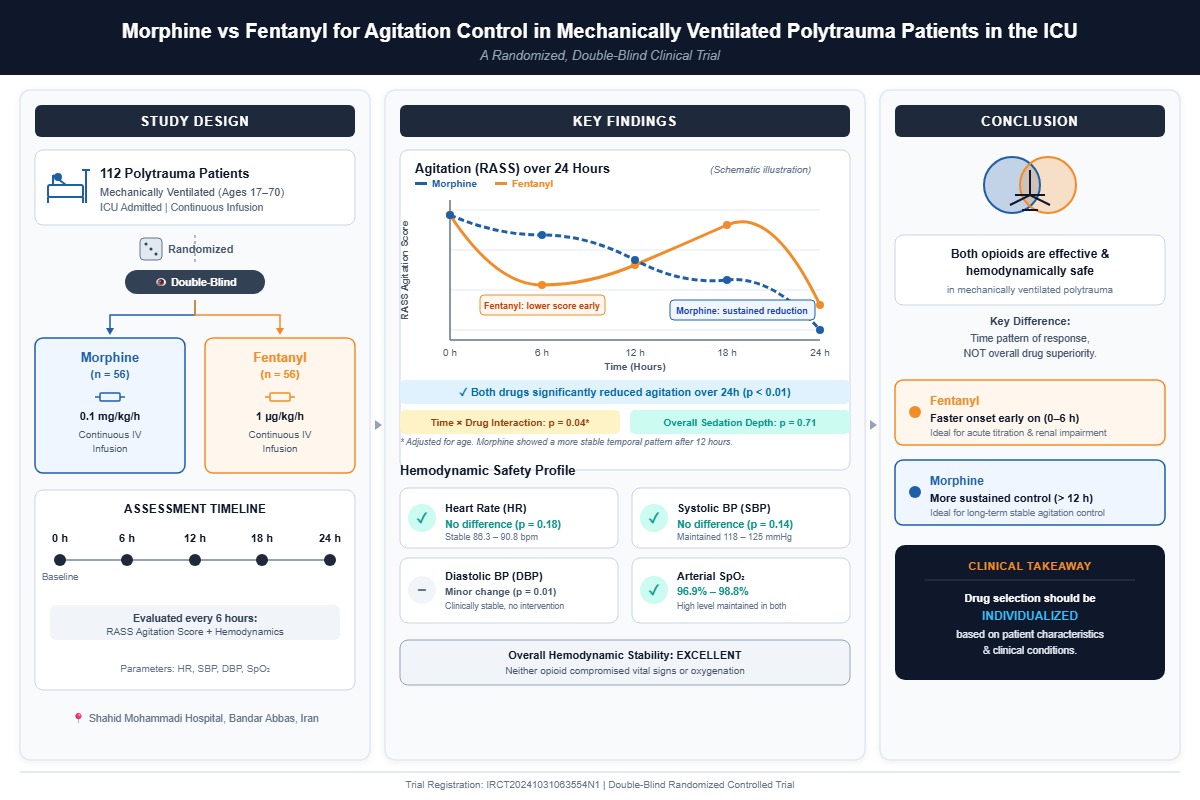
Materials and methods: This randomised, double-blind clinical trial was conducted at Shahid Mohammadi Hospital and included 112 mechanically ventilated patients with polytrauma aged 17-70 years. Participants were randomly assigned to receive a continuous intravenous infusion of either morphine (0.1 mg/kg/h) or fentanyl (1 µg/kg/h). Agitation was assessed using the Richmond Agitation-Sedation Scale (RASS) every six hours over 24 hours. Haemodynamic parameters were assessed at the same time points.
Results: RASS scores decreased significantly over the 24-hour observation period in both groups (P < 0.01). At 12 hours, the reduction in agitation was greater in the morphine group than in the fentanyl group (P = 0.04, adjusted for age). No significant between-group differences were observed in overall sedation depth (P = 0.71), heart rate (P = 0.18), or systolic blood pressure (P = 0.14). Diastolic blood pressure differed significantly between the groups (P = 0.01), although the changes were reported to remain clinically stable. Arterial oxygen saturation remained high in both groups, ranging from 96.93% to 98.84%.
Conclusion: Both morphine and fentanyl were associated with reductions in agitation in mechanically ventilated patients with polytrauma, with no significant between-group differences in heart rate or systolic blood pressure. Although morphine was associated with a greater reduction in agitation at 12 hours, the findings do not establish an overall superiority of either opioid. Opioid selection should therefore be guided by individual patient characteristics, clinical status, and the intended sedation and analgesia goals.
(Clinical Trials Registry Number: IRCT20241031063554N1)
Type of Study: Research(Original) |
Subject:
anesthesia
Send email to the article author
| Rights and permissions | |
 |
This work is licensed under a Creative Commons Attribution-NonCommercial 4.0 International License. |

Articles Copyright © The Author(s). Owned by Mazandaran University of Medical Sciences.
Contact Us
Address: Journal Office, Building No. 2, Mazandaran University of Medical Sciences, Moallem Square, Sari.Tel: +98 (011)34484874 Postal code: 48175-866 E-Mail: jmums@mazums.ac.ir Telefax: +98 (011)33262679
