

Volume 36, Issue 261 (10-2026)
J Mazandaran Univ Med Sci 2026, 36(261): 274-289 |
Back to browse issues page



Download citation:
BibTeX | RIS | EndNote | Medlars | ProCite | Reference Manager | RefWorks
Send citation to:


BibTeX | RIS | EndNote | Medlars | ProCite | Reference Manager | RefWorks
Send citation to:
Elahdadi Salmani M, Hajinezhad Sorkhi M. Ectopic Orexin Expression Beyond the Lateral Hypothalamus Under Pathological Conditions: A Review of Current Evidence, Hypotheses, and Challenges. J Mazandaran Univ Med Sci 2026; 36 (261) :274-289
URL: http://jmums.mazums.ac.ir/article-1-23031-en.html
URL: http://jmums.mazums.ac.ir/article-1-23031-en.html


Abstract: (19 Views)
Background and purpose: Neurons in the lateral hypothalamus produce orexin and project extensively throughout the brain and spinal cord, where orexin modulates essential functions including feeding, reward, emotion, and stress responses. At the molecular level, orexin is derived from a precursor protein, prepro-orexin, which is enzymatically cleaved by prohormone convertases to generate two active forms: orexin-A and orexin-B.
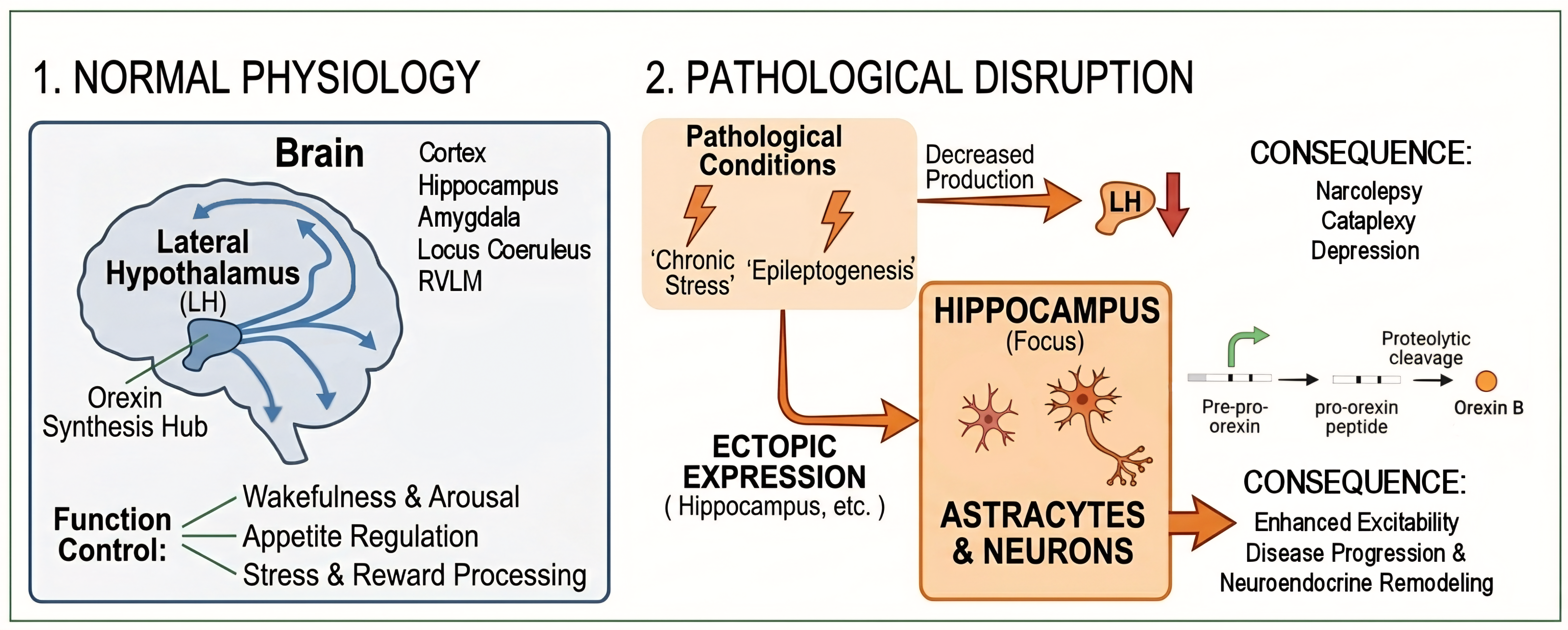
While orexin expression has been documented in several peripheral tissues outside the brain, local synthesis within extra-hypothalamic neural tissue has not been observed under normal conditions. Dysregulation of the orexin system may contribute to or result from disease processes; for instance, central orexin depletion is well documented in narcolepsy with cataplexy. Recent preclinical data suggest that, in pathological conditions such as chronic stress and epilepsy, reduced hypothalamic orexin output and diminished orexin release in target regions may induce compensatory responses or maladaptive reorganisation within limbic structures such as the hippocampus. In support of this possibility, limited evidence has suggested local expression of prepro-orexin mRNA in the hippocampus and amygdala. Furthermore, one study reported selective synthesis of orexin-B in specific hippocampal cell types, including astrocytes and interneurons. Nevertheless, whether this local production contributes directly to disease progression through alterations in cellular excitability remains a possible hypothesis requiring broader experimental validation. Through a review of the current literature, this paper critically examines alterations in orexin-system expression under pathological conditions, distinguishes established findings from current hypotheses, and highlights methodological challenges and research gaps in this emerging field.
While orexin expression has been documented in several peripheral tissues outside the brain, local synthesis within extra-hypothalamic neural tissue has not been observed under normal conditions. Dysregulation of the orexin system may contribute to or result from disease processes; for instance, central orexin depletion is well documented in narcolepsy with cataplexy. Recent preclinical data suggest that, in pathological conditions such as chronic stress and epilepsy, reduced hypothalamic orexin output and diminished orexin release in target regions may induce compensatory responses or maladaptive reorganisation within limbic structures such as the hippocampus. In support of this possibility, limited evidence has suggested local expression of prepro-orexin mRNA in the hippocampus and amygdala. Furthermore, one study reported selective synthesis of orexin-B in specific hippocampal cell types, including astrocytes and interneurons. Nevertheless, whether this local production contributes directly to disease progression through alterations in cellular excitability remains a possible hypothesis requiring broader experimental validation. Through a review of the current literature, this paper critically examines alterations in orexin-system expression under pathological conditions, distinguishes established findings from current hypotheses, and highlights methodological challenges and research gaps in this emerging field.
Type of Study: Review |
Subject:
physiology
Send email to the article author
| Rights and permissions | |
 |
This work is licensed under a Creative Commons Attribution-NonCommercial 4.0 International License. |

Articles Copyright © The Author(s). Owned by Mazandaran University of Medical Sciences.
Contact Us
Address: Journal Office, Building No. 2, Mazandaran University of Medical Sciences, Moallem Square, Sari.Tel: +98 (011)34484874 Postal code: 48175-866 E-Mail: jmums@mazums.ac.ir Telefax: +98 (011)33262679
