

Volume 36, Issue 263 (11-2026)
J Mazandaran Univ Med Sci 2026, 36(263): 100-111 |
Back to browse issues page



Download citation:
BibTeX | RIS | EndNote | Medlars | ProCite | Reference Manager | RefWorks
Send citation to:


BibTeX | RIS | EndNote | Medlars | ProCite | Reference Manager | RefWorks
Send citation to:
Mokhlesin M, Zhian Ahani S, Ahmadizadeh Z. Association Between Dysphagia Severity and Its Impact on Caregivers’ Lives Among Iranian Children with Cerebral Palsy. , J Mazandaran Univ Med Sci. 2026; 36 (263) :100-111
URL: http://jmums.mazums.ac.ir/article-1-23065-en.html
URL: http://jmums.mazums.ac.ir/article-1-23065-en.html


Abstract: (28 Views)
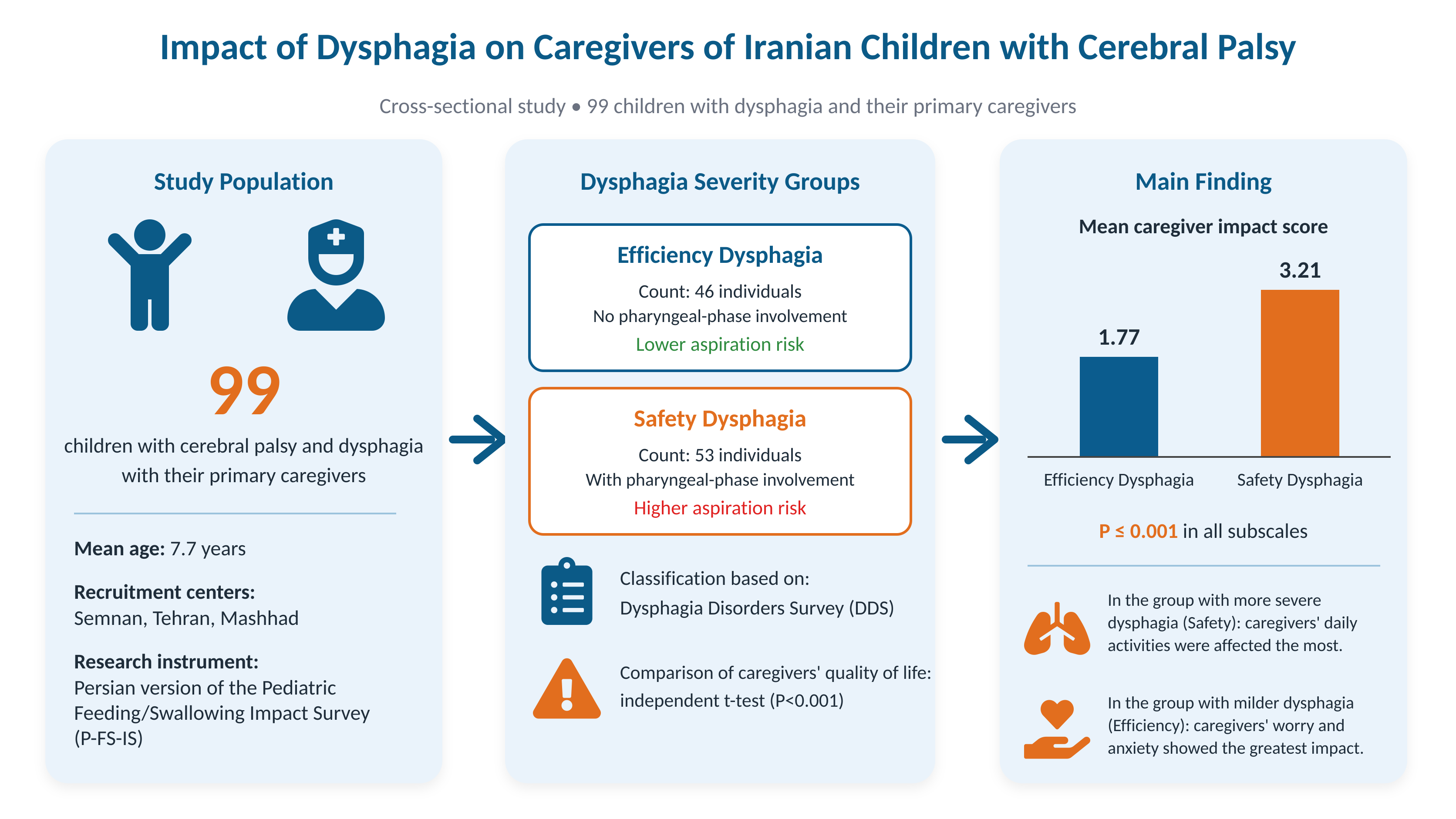
Background and purpose: Caring for children with disabilities can be challenging and stressful and may adversely affect caregivers’ health and well-being. Dysphagia in children with cerebral palsy (CP) may negatively affect caregivers’ quality of life by increasing caregiving demands and the risk of swallowing-related complications. Despite the importance of this issue, few studies have examined the association between dysphagia severity and caregivers’ quality of life, and evidence from the Iranian population remains limited. This study aimed to investigate the impact of dysphagia on the quality of life of caregivers of Iranian children with CP and its association with pharyngeal-phase involvement.
Materials and methods: In this cross-sectional study, 126 children with CP were recruited through convenience sampling from rehabilitation centres in Mashhad, Tehran and Semnan. Following the application of the inclusion and exclusion criteria, 99 children with dysphagia were included in the final analysis. The children were divided into two groups according to whether pharyngeal-phase involvement was present or absent. Primary caregivers completed the Persian version of the Feeding/Swallowing Impact Survey (P-FS-IS). Independent-samples t-tests were used to compare the groups, and analysis of covariance (ANCOVA) was performed to examine between-group differences after adjustment for gross motor function.
Results: Caregivers of children with pharyngeal-phase involvement had significantly higher P-FS-IS scores than those of children without pharyngeal-phase involvement (P < 0.001). This difference remained significant after controlling for gross motor function (F(1, 96) = 51.74, P < 0.001, partial η² = 0.35). Among caregivers of children without pharyngeal-phase involvement, the highest scores were observed in the caregiver concern subscale, whereas daily activities was the most affected subscale among caregivers of children with pharyngeal-phase involvement.
Conclusion: Pharyngeal-phase involvement in children with CP was associated with a greater impact of feeding and swallowing difficulties on caregivers’ quality of life, even after adjustment for gross motor function. Therefore, alongside the assessment and treatment of paediatric dysphagia, routine screening for caregiver burden, caregiver education, and psychological and family-centred support should be incorporated into paediatric dysphagia management.
Type of Study: Research(Original) |
Subject:
Speech Therapy
| Rights and permissions | |
 |
This work is licensed under a Creative Commons Attribution-NonCommercial 4.0 International License. |

Articles Copyright © The Author(s). Owned by Mazandaran University of Medical Sciences.
Contact Us
Address: Journal Office, Building No. 2, Mazandaran University of Medical Sciences, Moallem Square, Sari.Tel: +98 (011)34484874 Postal code: 48175-866 E-Mail: jmums@mazums.ac.ir Telefax: +98 (011)33262679
