

Volume 36, Issue 262 (Special Issue 2026)
J Mazandaran Univ Med Sci 2026, 36(262): 257-271 |
Back to browse issues page



Download citation:
BibTeX | RIS | EndNote | Medlars | ProCite | Reference Manager | RefWorks
Send citation to:


BibTeX | RIS | EndNote | Medlars | ProCite | Reference Manager | RefWorks
Send citation to:
Musavi H, Moslemi F, Bahmani F, honakdar-Tarsi A. Beyond HbA1c: Complementary Biomarkers and Emerging Technologies for Precision Glycemic Assessment in Diabetes. , J Mazandaran Univ Med Sci. 2026; 36 (262) :257-271
URL: http://jmums.mazums.ac.ir/article-1-23096-en.html
URL: http://jmums.mazums.ac.ir/article-1-23096-en.html


Abstract: (35 Views)
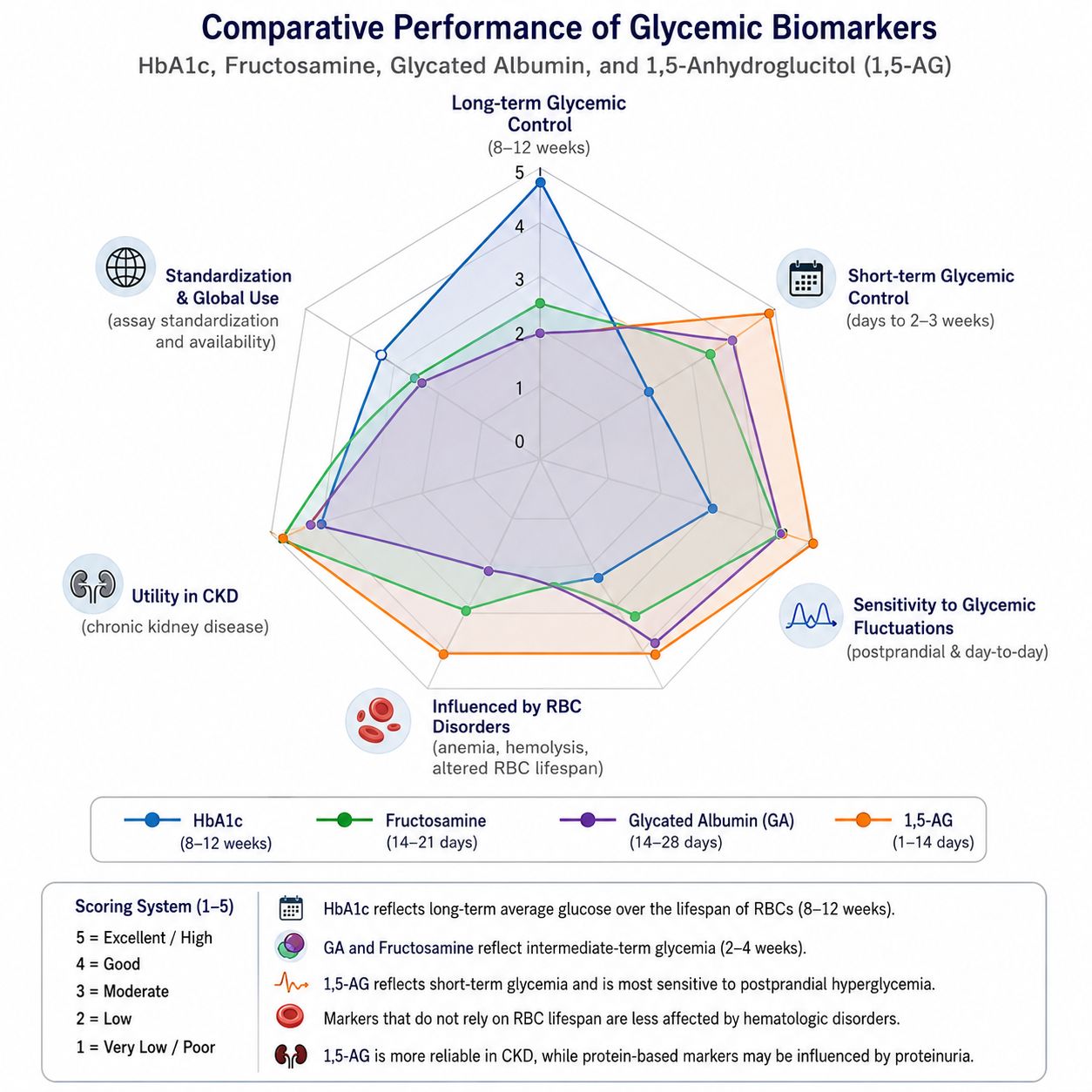
Glycated hemoglobin (HbA1c) is a key clinical measure of long-term glycemic control and the risk of diabetes-related complications. However, its interpretation can be affected by changes in red blood cell lifespan, hemoglobinopathies, and other clinical conditions, and it does not directly reflect short-term glucose fluctuations or episodes of hypoglycemia and hyperglycemia. This review evaluates complementary biomarkers and emerging technologies for glycemic monitoring, focusing on their biochemical characteristics, temporal windows of glycemic assessment, measurement methods, advantages, limitations, and clinical applications. Fructosamine, glycated albumin (GA), and 1,5-anhydroglucitol (1,5-AG) are reviewed as complementary biomarkers alongside continuous glucose monitoring (CGM)-derived metrics, including time in range (TIR) and glycemic variability. 1,5-Anhydroglucitol primarily reflects recent glycemic excursions over approximately 1-2 weeks, whereas fructosamine reflects glycemic control over approximately 2-4 weeks and GA over approximately 2-3 weeks. In contrast, HbA1c reflects glycemic exposure over approximately 8-12 weeks, with glucose levels during the preceding weeks contributing more substantially to the measured value. Together, these complementary assessment periods provide information on glycemic patterns across different time scales and may support treatment adjustment. Emerging approaches, including advanced glycation-related biomarkers, wearable and noninvasive sensors, microneedle-based technologies, and artificial intelligence applications for glycemic data analysis, are also reviewed as potential strategies for more precise and comprehensive glycemic assessment. These approaches may help identify discordance between average glycemia and day-to-day glucose patterns. Integrating HbA1c with complementary biomarkers and CGM-derived metrics may provide a more comprehensive assessment of glycemic status across different time scales and support treatment adjustment and personalized diabetes management.
Keywords: diabetes mellitus, glycated hemoglobin (HbA1c), complementary glycemic biomarkers, fructosamine, glycated albumin, 1, 5-anhydroglucitol (1, 5-AG), continuous glucose monitoring (CGM), time in range (TIR), glycemic variability, precision glycemic assessment
Type of Study: Review |
Subject:
Sports biomechanics
| Rights and permissions | |
 |
This work is licensed under a Creative Commons Attribution-NonCommercial 4.0 International License. |

Articles Copyright © The Author(s). Owned by Mazandaran University of Medical Sciences.
Contact Us
Address: Journal Office, Building No. 2, Mazandaran University of Medical Sciences, Moallem Square, Sari.Tel: +98 (011)34484874 Postal code: 48175-866 E-Mail: jmums@mazums.ac.ir Telefax: +98 (011)33262679
