

Volume 36, Issue 262 (Special Issue 2026)
J Mazandaran Univ Med Sci 2026, 36(262): 153-168 |
Back to browse issues page



Download citation:
BibTeX | RIS | EndNote | Medlars | ProCite | Reference Manager | RefWorks
Send citation to:


BibTeX | RIS | EndNote | Medlars | ProCite | Reference Manager | RefWorks
Send citation to:
Ehsani J, Mortazavian A M, Khomeiri M, Ghasemnezhad A. Evaluation of the Organoleptic Characteristics of Functional Yogurt Containing Probiotic Bacteria and Artichoke Extract Immediately After Production. , J Mazandaran Univ Med Sci. 2026; 36 (262) :153-168
URL: http://jmums.mazums.ac.ir/article-1-23117-en.html
URL: http://jmums.mazums.ac.ir/article-1-23117-en.html


Abstract: (46 Views)
Background and purpose: Functional foods, in addition to providing basic nutritional value, may confer health benefits and reduce the risk of chronic diseases. This category of products encompasses a wide range of foods enriched with vitamins and minerals, antioxidants, soy protein, essential fatty acids, prebiotics, and probiotics.
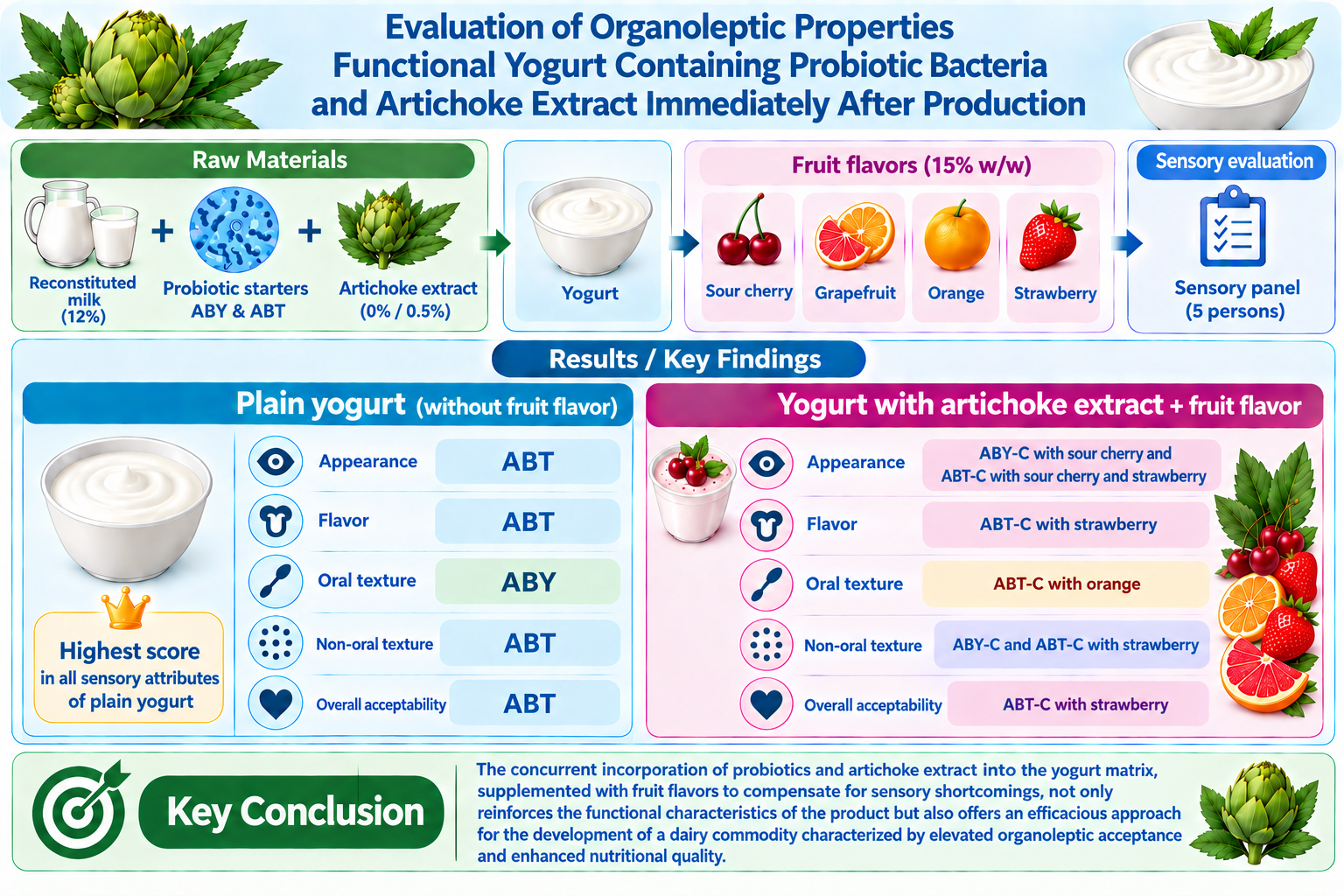
Materials and methods: In this experimental study, functional yogurt was prepared using reconstituted milk with a 12% solids content and two probiotic starter cultures, namely ABY (Lactobacillus acidophilus, Bifidobacterium lactis, Streptococcus thermophilus, and Lactobacillus bulgaricus) and ABT (Lactobacillus acidophilus, Bifidobacterium lactis, and Streptococcus thermophilus), with the addition of artichoke extract at concentrations of 0% and 0.5%. At the end of the incubation stage, the organoleptic characteristics of the yogurt samples (with/without the addition of fruit flavors) were evaluated, including flavor, oral texture, appearance, non-oral texture, and overall acceptability.
Results: The highest panelist scores for appearance, taste, non-oral texture, and overall acceptability (in the samples without fruit flavor) were recorded for the ABT sample; the highest score for oral texture was recorded for the ABY sample. Following the addition of fruit flavors (sour cherry, grapefruit, orange, and strawberry) to the yogurt samples, the highest scores for appearance, taste, oral texture, non-oral texture, and overall acceptability among the samples containing artichoke extract were assigned, respectively, to the ABY-C sample with sour cherry flavor; the ABT-C samples with sour cherry and strawberry flavors; the ABT-C sample with strawberry flavor; the ABT-C sample with orange flavor; the ABY-C and ABT-C samples with strawberry flavor; and the ABT-C sample with strawberry flavor.
Conclusion: The concurrent incorporation of probiotics and artichoke extract into the yogurt matrix, supplemented with fruit flavors to compensate for sensory shortcomings, may enhance the functional characteristics of the product while providing an approach to developing a dairy product with high sensory acceptability and improved nutritional quality.
Type of Study: Research(Original) |
Subject:
Food industry
Send email to the article author
| Rights and permissions | |
 |
This work is licensed under a Creative Commons Attribution-NonCommercial 4.0 International License. |

Articles Copyright © The Author(s). Owned by Mazandaran University of Medical Sciences.
Contact Us
Address: Journal Office, Building No. 2, Mazandaran University of Medical Sciences, Moallem Square, Sari.Tel: +98 (011)34484874 Postal code: 48175-866 E-Mail: jmums@mazums.ac.ir Telefax: +98 (011)33262679
