

Volume 36, Issue 261 (10-2026)
J Mazandaran Univ Med Sci 2026, 36(261): 97-109 |
Back to browse issues page



Download citation:
BibTeX | RIS | EndNote | Medlars | ProCite | Reference Manager | RefWorks
Send citation to:


BibTeX | RIS | EndNote | Medlars | ProCite | Reference Manager | RefWorks
Send citation to:
Latifi A, Nejadsadeghi E, Haghighizadeh M H, Babaei Heydarabadi A. Development and Initial Psychometric Evaluation of a Health Belief Model-Based Questionnaire Assessing Preventive Behaviors Related to Electronic Device-Associated Musculoskeletal Disorders among High School Students. J Mazandaran Univ Med Sci 2026; 36 (261) :97-109
URL: http://jmums.mazums.ac.ir/article-1-23207-en.html
URL: http://jmums.mazums.ac.ir/article-1-23207-en.html


Abstract: (18 Views)
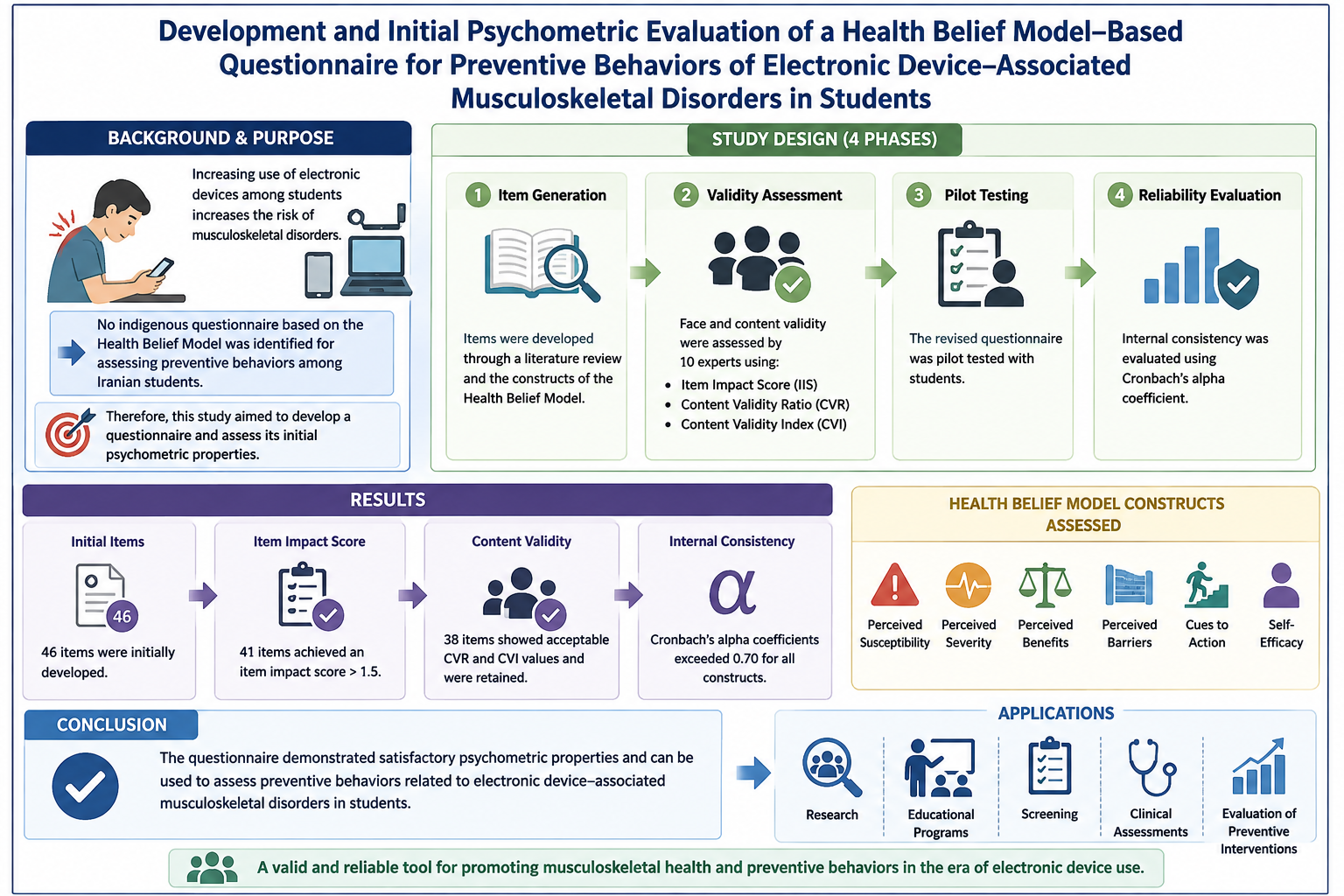
Background and purpose: Increasing use of electronic devices, including cell phones, tablet computers, and computers, has been associated with an increased risk of musculoskeletal disorders among students. Effective educational interventions require valid and reliable instruments to assess preventive behaviors. This study aimed to develop a questionnaire and conduct a preliminary assessment of its psychometric properties to evaluate preventive behaviors related to musculoskeletal disorders associated with electronic device use.
Materials and methods: This methodological study was conducted in four phases: item generation, validity assessment, pilot testing, and reliability evaluation. Items were developed through a literature review and based on the constructs of the Health Belief Model. Face validity was assessed using the impact score, while content validity was evaluated by 10 experts using the Content Validity Ratio (CVR) and Content Validity Index (CVI). Internal consistency was evaluated using Cronbach’s alpha coefficient.
Results: Of the 46 initial items, 41 achieved an item impact score of >1.5. Following the content validity assessment, 38 items showed acceptable CVR and CVI values and were retained. The CVR values of the retained items ranged from 0.80 to 1.00, while the CVI values ranged from 0.90 to 1.00. Cronbach’s alpha coefficients of 0.70 or higher were obtained for all Health Belief Model constructs, providing preliminary evidence of the internal consistency of the items within each construct.
Conclusion: The developed questionnaire may be useful for related research, needs assessment, and educational planning, based on preliminary evidence of face and content validity and internal consistency. However, further studies are required to comprehensively evaluate the instrument’s psychometric properties before it can be considered suitable for definitive use.
Materials and methods: This methodological study was conducted in four phases: item generation, validity assessment, pilot testing, and reliability evaluation. Items were developed through a literature review and based on the constructs of the Health Belief Model. Face validity was assessed using the impact score, while content validity was evaluated by 10 experts using the Content Validity Ratio (CVR) and Content Validity Index (CVI). Internal consistency was evaluated using Cronbach’s alpha coefficient.
Results: Of the 46 initial items, 41 achieved an item impact score of >1.5. Following the content validity assessment, 38 items showed acceptable CVR and CVI values and were retained. The CVR values of the retained items ranged from 0.80 to 1.00, while the CVI values ranged from 0.90 to 1.00. Cronbach’s alpha coefficients of 0.70 or higher were obtained for all Health Belief Model constructs, providing preliminary evidence of the internal consistency of the items within each construct.
Conclusion: The developed questionnaire may be useful for related research, needs assessment, and educational planning, based on preliminary evidence of face and content validity and internal consistency. However, further studies are required to comprehensively evaluate the instrument’s psychometric properties before it can be considered suitable for definitive use.
Keywords: musculoskeletal disorders, preventive health behavior, psychometrics, Health Belief Model, students
Type of Study: Research(Original) |
Subject:
Health Education
Send email to the article author
| Rights and permissions | |
 |
This work is licensed under a Creative Commons Attribution-NonCommercial 4.0 International License. |

Articles Copyright © The Author(s). Owned by Mazandaran University of Medical Sciences.
Contact Us
Address: Journal Office, Building No. 2, Mazandaran University of Medical Sciences, Moallem Square, Sari.Tel: +98 (011)34484874 Postal code: 48175-866 E-Mail: jmums@mazums.ac.ir Telefax: +98 (011)33262679
