

Volume 36, Issue 263 (11-2026)
J Mazandaran Univ Med Sci 2026, 36(263): 76-89 |
Back to browse issues page



Download citation:
BibTeX | RIS | EndNote | Medlars | ProCite | Reference Manager | RefWorks
Send citation to:


BibTeX | RIS | EndNote | Medlars | ProCite | Reference Manager | RefWorks
Send citation to:
Salari Telmadareh Z, Arian S, Dehpour A A, Sadeghi B, Ghorbanalinezhad E. Prevalence of Selected Class A Extended-Spectrum Beta-Lactamase Genes in Multidrug-Resistant Pseudomonas aeruginosa and Acinetobacter baumannii Isolates from Teaching Hospitals in Mazandaran, Iran. , J Mazandaran Univ Med Sci. 2026; 36 (263) :76-89
URL: http://jmums.mazums.ac.ir/article-1-23308-en.html
URL: http://jmums.mazums.ac.ir/article-1-23308-en.html
Zahra Salari Telmadareh 
 , Simin Arian * , Abbas Ali Dehpour , Babak Sadeghi , Esmaeil Ghorbanalinezhad
Abstract: (24 Views)
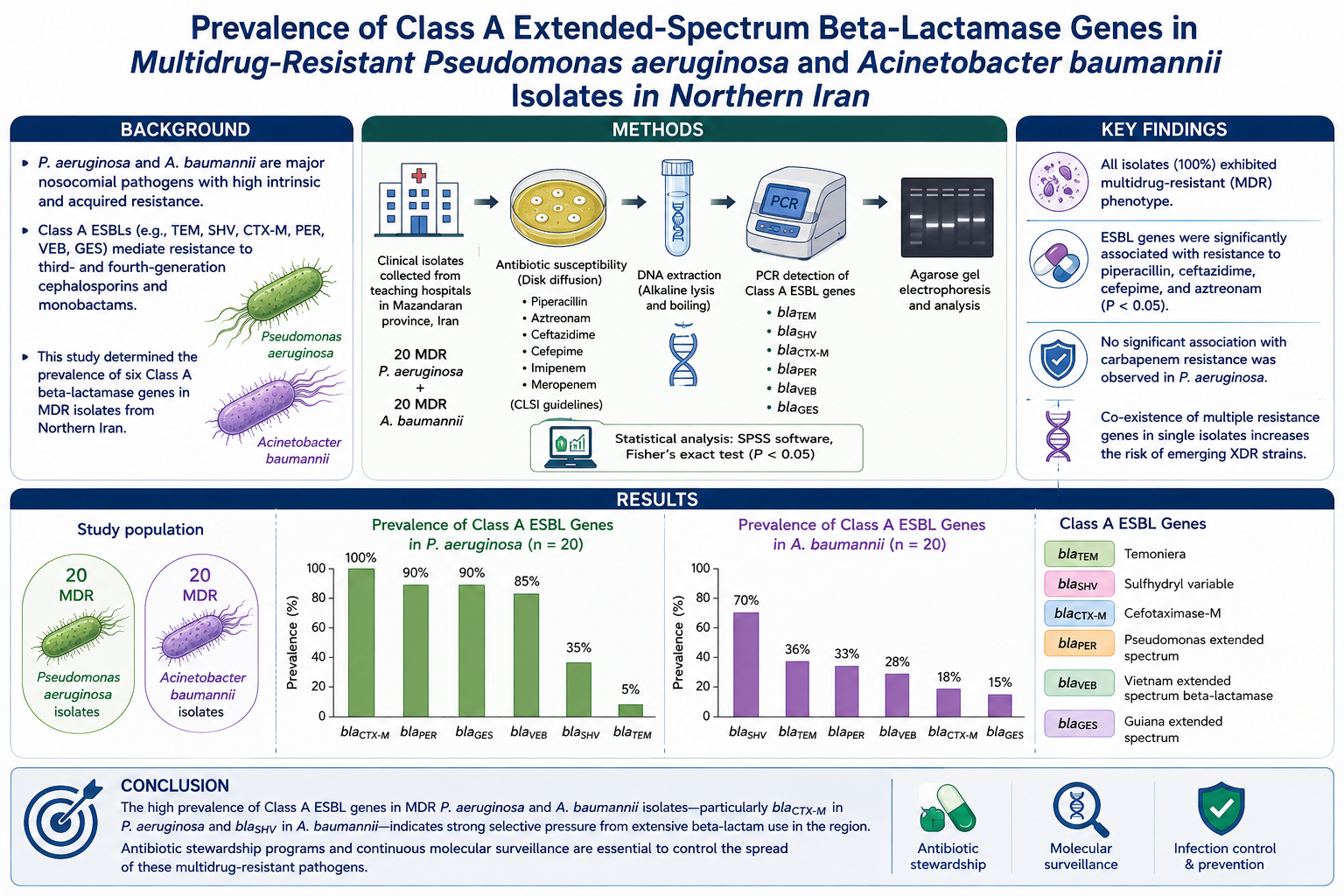
Background and purpose: Class A extended-spectrum beta-lactamases (ESBLs) are a major mechanism of resistance to third- and fourth-generation cephalosporins and monobactams among Pseudomonas aeruginosa and Acinetobacter baumannii. This study aimed to determine the prevalence of blaTEM, blaSHV, blaCTX-M, blaPER, blaVEB, and blaGES genes in 20 multidrug-resistant (MDR) P. aeruginosa and 20 MDR A. baumannii clinical isolates obtained from teaching hospitals affiliated with Mazandaran University of Medical Sciences.
Materials and methods: Clinical isolates were collected from teaching hospitals in Mazandaran province and identified using standard microbiological and biochemical tests. The antimicrobial susceptibility of the isolates to beta-lactams (piperacillin, aztreonam, ceftazidime, cefepime, imipenem, and meropenem) was determined using the disk diffusion method in accordance with CLSI guidelines. Genomic DNA was extracted using alkaline lysis and boiling, and the presence of the target genes was investigated using polymerase chain reaction (PCR) with specific primers. Data were analyzed using SPSS software and Fisher's exact test.
Results: All isolates (100%) exhibited an MDR phenotype. In P. aeruginosa isolates, the blaCTX-M gene was the most prevalent (100%), followed by blaPER (90%), blaGES (90%), blaVEB (85%), blaSHV (35%), and blaTEM (5%). In A. baumannii isolates, the blaSHV gene was the most frequent (80%), followed by blaTEM (25%), blaPER (60%), blaVEB (20%), blaCTX-M (15%), and blaGES (10%).
Conclusion: The high prevalence of class A ESBL genes in MDR isolates of these two important pathogens, particularly the high prevalence of blaCTX-M in P. aeruginosa and blaSHV in A. baumannii, indicates substantial selective pressure associated with the widespread use of beta-lactam antibiotics in the region. The concurrent presence of multiple resistance genes within a single isolate may increase the risk of the emergence of extensively drug-resistant (XDR) strains. Therefore, antibiotic stewardship and continuous molecular surveillance of resistance genes are essential for controlling the spread of these strains.
Keywords: Pseudomonas aeruginosa, Acinetobacter baumannii, extended-spectrum beta-lactamases (ESBLs), multidrug-resistant (MDR), Class A beta-lactamase genes, Iran
Type of Study: Research(Original) |
Subject:
Microbiology
| Rights and permissions | |
 |
This work is licensed under a Creative Commons Attribution-NonCommercial 4.0 International License. |

Articles Copyright © The Author(s). Owned by Mazandaran University of Medical Sciences.
Contact Us
Address: Journal Office, Building No. 2, Mazandaran University of Medical Sciences, Moallem Square, Sari.Tel: +98 (011)34484874 Postal code: 48175-866 E-Mail: jmums@mazums.ac.ir Telefax: +98 (011)33262679
