

Volume 36, Issue 255 (3-2026)
J Mazandaran Univ Med Sci 2026, 36(255): 21-29 |
Back to browse issues page


Download citation:
BibTeX | RIS | EndNote | Medlars | ProCite | Reference Manager | RefWorks
Send citation to:


BibTeX | RIS | EndNote | Medlars | ProCite | Reference Manager | RefWorks
Send citation to:
Gholami A, Jahangiri M R, Gholinia H, Mousavie Anijdan S H. Efficacy of percutaneous ethanol injection in the treatment of local recurrence of papillary thyroid carcinoma. J Mazandaran Univ Med Sci 2026; 36 (255) :21-29
URL: http://jmums.mazums.ac.ir/article-1-22260-en.html
URL: http://jmums.mazums.ac.ir/article-1-22260-en.html


Abstract: (106 Views)
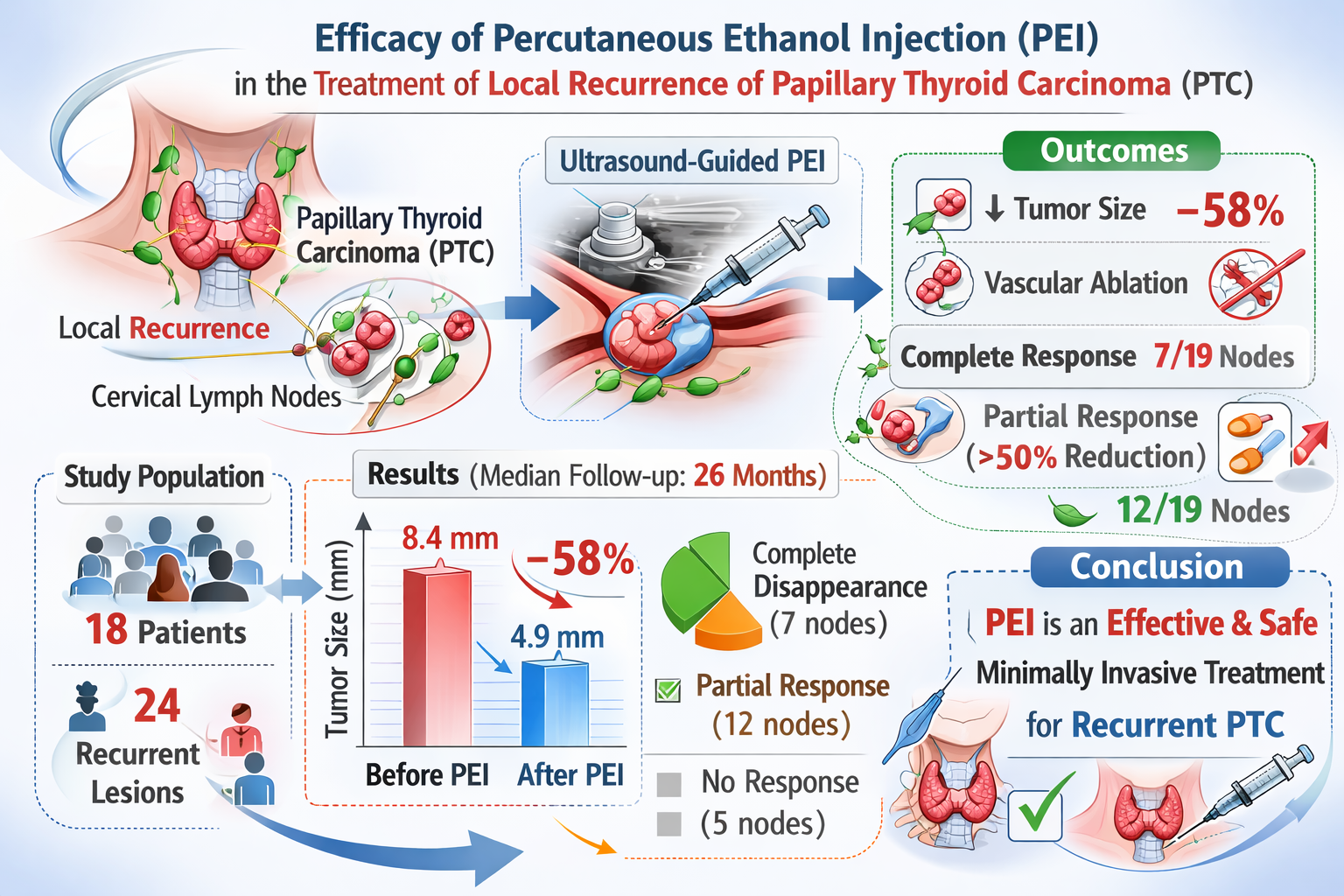
Background and purpose: Papillary thyroid carcinoma is the most common endocrine malignancy. Despite complete initial surgical resection, a significant number of patients experience regional recurrence months or years later. Reoperation is challenging due to a high complication rate. The aim of this study is to investigate the efficacy of ablation therapy, specifically percutaneous ethanol injection (PEI), for managing local recurrence in cervical lymph nodes in patients with a history of papillary thyroid carcinoma (PTC) surgery.
Materials and methods: A retrospective study was conducted including 18 patients with local cervical lymph node recurrence, confirmed by ultrasound, biopsy, and cytological evaluation of metastatic involvement. These patients were candidates for ultrasound‑guided percutaneous ethanol injection (PEI). Successful treatment was defined as complete disappearance of the lymph node or a reduction in its size by more than 50%, accompanied by the absence of blood flow on ultrasound. Treatment failure was defined as an increase in the size of the injected lymph node or the persistence of vascular flow.
Results: During a median follow-up period of 26 months, 24 recurrent lesions were identified in 18 patients. The mean short‑axis diameter of the lesions decreased from 8.4 mm to 4.9 mm following PEI treatment, representing a 58% volume reduction. Among the 19 lymph nodes successfully treated in 14 patients, 7 nodes completely disappeared, while 12 nodes showed a size reduction of more than 50% with a significant decrease in flow or no vascular flow.
Conclusion: This study demonstrates that PEI is an effective and safe minimally invasive treatment option for recurrent PTC in cervical lymph nodes among selected patients who are not eligible for surgery or who refuse reoperation.
Materials and methods: A retrospective study was conducted including 18 patients with local cervical lymph node recurrence, confirmed by ultrasound, biopsy, and cytological evaluation of metastatic involvement. These patients were candidates for ultrasound‑guided percutaneous ethanol injection (PEI). Successful treatment was defined as complete disappearance of the lymph node or a reduction in its size by more than 50%, accompanied by the absence of blood flow on ultrasound. Treatment failure was defined as an increase in the size of the injected lymph node or the persistence of vascular flow.
Results: During a median follow-up period of 26 months, 24 recurrent lesions were identified in 18 patients. The mean short‑axis diameter of the lesions decreased from 8.4 mm to 4.9 mm following PEI treatment, representing a 58% volume reduction. Among the 19 lymph nodes successfully treated in 14 patients, 7 nodes completely disappeared, while 12 nodes showed a size reduction of more than 50% with a significant decrease in flow or no vascular flow.
Conclusion: This study demonstrates that PEI is an effective and safe minimally invasive treatment option for recurrent PTC in cervical lymph nodes among selected patients who are not eligible for surgery or who refuse reoperation.
Keywords: Papillary thyroid carcinoma, percutaneous ethanol injection, radioactive iodine therapy, thyroid remnant, thyroglobulin.
Type of Study: Research(Original) |
Subject:
Nuclear medicine
Send email to the article author
| Rights and permissions | |
 |
This work is licensed under a Creative Commons Attribution-NonCommercial 4.0 International License. |

Articles Copyright © The Author(s). Owned by Mazandaran University of Medical Sciences.
Contact Us
Address: Journal Office, Building No. 2, Mazandaran University of Medical Sciences, Moallem Square, Sari.Tel: +98 (011)34484874 Postal code: 48175-866 E-Mail: jmums@mazums.ac.ir Telefax: +98 (011)33262679
