

Volume 36, Issue 259 (8-2026)
J Mazandaran Univ Med Sci 2026, 36(259): 191-203 |
Back to browse issues page



Download citation:
BibTeX | RIS | EndNote | Medlars | ProCite | Reference Manager | RefWorks
Send citation to:


BibTeX | RIS | EndNote | Medlars | ProCite | Reference Manager | RefWorks
Send citation to:
Barimani Aboksari Z, Hamzehgardeshi Z, Khani S, Shahhosseini Z. Interventions to Promote Childbearing in Iran: A Scoping Review. J Mazandaran Univ Med Sci 2026; 36 (259) :191-203
URL: http://jmums.mazums.ac.ir/article-1-22726-en.html
URL: http://jmums.mazums.ac.ir/article-1-22726-en.html


Abstract: (569 Views)
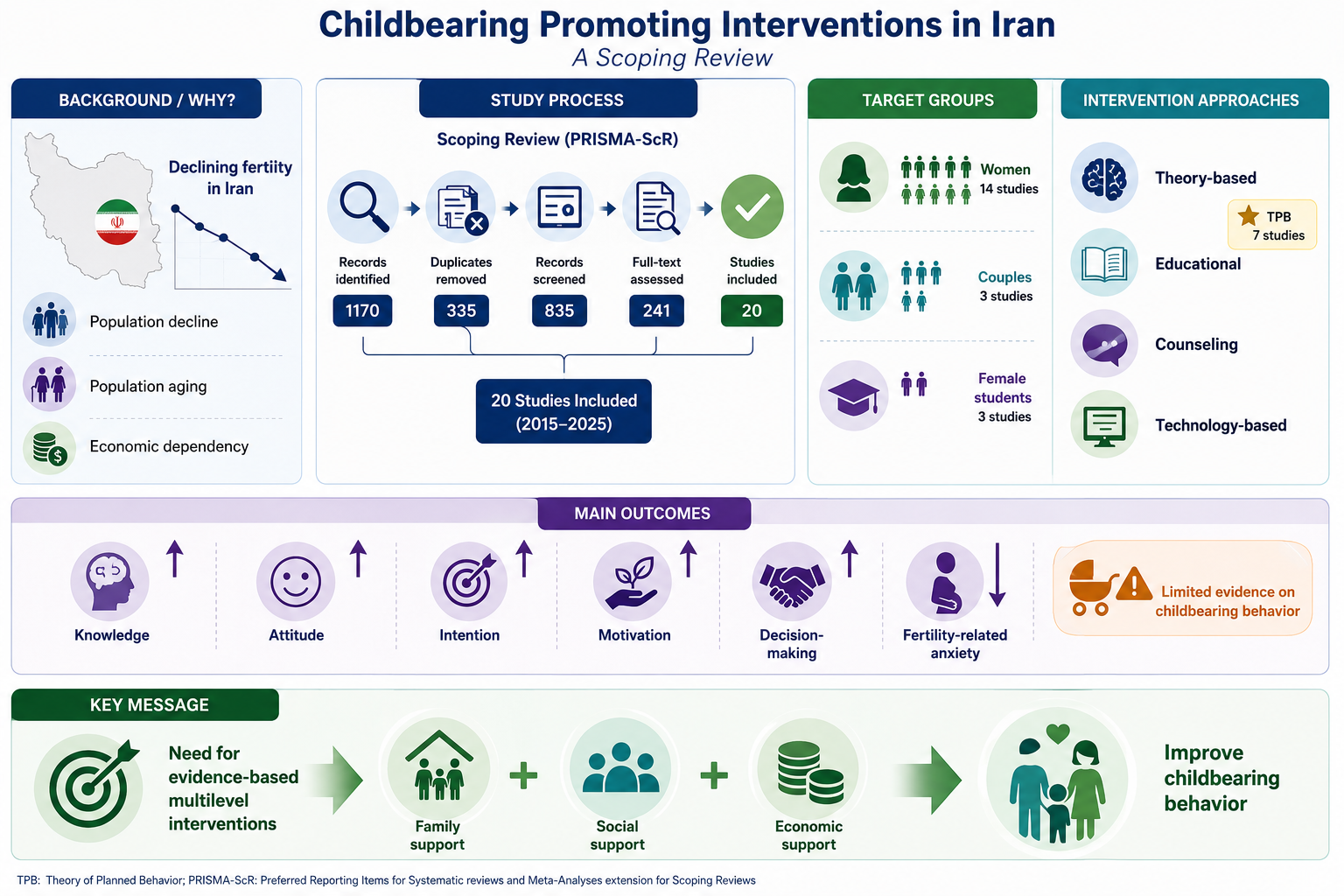
Background and purpose: Fertility is one of the main determinants of population growth. Over the past several decades, the fertility rate in Iran has shown a declining trend and is currently below the replacement level. The continuation of this trend may lead to consequences such as population decline, ageing, and increased economic dependence. Therefore, the present study aimed to conduct a scoping review to identify, map, and summarize the characteristics and outcomes of interventions designed to encourage childbearing in Iran.
Materials and methods: This scoping review was conducted in accordance with the PRISMA-ScR guidelines. PubMed, Web of Science, Scopus, SID, and Google Scholar were searched using the keywords "childbearing," "fertility," "reproductive health," "reproductive behaviour," "intervention," "interventional," "experimental," "trial," "programme," "counselling," "Iran," and "Iranian," along with their Persian equivalents, for studies published between 2015 and 2025. A total of 1,170 studies were identified. After removing duplicates and screening titles, abstracts, and full-text articles according to the eligibility criteria, 20 studies were included in the final review.
Results: The included studies were categorized into three groups: interventions targeting women, couples, and female university students. Interventions were mainly based on theoretical, educational, counselling, and technology-based approaches. Most interventions were associated with improvements in knowledge, attitudes, intentions, and motivation towards childbearing.
Conclusion: Although the existing interventions have mainly demonstrated positive effects on cognitive and psychological outcomes, limited evidence is available regarding their impact on childbearing behaviour. Therefore, the development of multilevel, evidence-based interventions, aligned with economic, social, and family support measures, is recommended to enhance effectiveness and improve childbearing behaviour at the population level.
Materials and methods: This scoping review was conducted in accordance with the PRISMA-ScR guidelines. PubMed, Web of Science, Scopus, SID, and Google Scholar were searched using the keywords "childbearing," "fertility," "reproductive health," "reproductive behaviour," "intervention," "interventional," "experimental," "trial," "programme," "counselling," "Iran," and "Iranian," along with their Persian equivalents, for studies published between 2015 and 2025. A total of 1,170 studies were identified. After removing duplicates and screening titles, abstracts, and full-text articles according to the eligibility criteria, 20 studies were included in the final review.
Results: The included studies were categorized into three groups: interventions targeting women, couples, and female university students. Interventions were mainly based on theoretical, educational, counselling, and technology-based approaches. Most interventions were associated with improvements in knowledge, attitudes, intentions, and motivation towards childbearing.
Conclusion: Although the existing interventions have mainly demonstrated positive effects on cognitive and psychological outcomes, limited evidence is available regarding their impact on childbearing behaviour. Therefore, the development of multilevel, evidence-based interventions, aligned with economic, social, and family support measures, is recommended to enhance effectiveness and improve childbearing behaviour at the population level.
Send email to the article author
| Rights and permissions | |
 |
This work is licensed under a Creative Commons Attribution-NonCommercial 4.0 International License. |

Articles Copyright © The Author(s). Owned by Mazandaran University of Medical Sciences.
Contact Us
Address: Journal Office, Building No. 2, Mazandaran University of Medical Sciences, Moallem Square, Sari.Tel: +98 (011)34484874 Postal code: 48175-866 E-Mail: jmums@mazums.ac.ir Telefax: +98 (011)33262679
