

Volume 36, Issue 261 (10-2026)
J Mazandaran Univ Med Sci 2026, 36(261): 64-71 |
Back to browse issues page



Download citation:
BibTeX | RIS | EndNote | Medlars | ProCite | Reference Manager | RefWorks
Send citation to:


BibTeX | RIS | EndNote | Medlars | ProCite | Reference Manager | RefWorks
Send citation to:
Kazemi Visari A, Jafari-Ramedani S, Ebrahimi Shahabi R. Prevalence of Celiac Disease among First-Degree Relatives of Patients with Celiac Disease in Mazandaran Province, Iran. J Mazandaran Univ Med Sci 2026; 36 (261) :64-71
URL: http://jmums.mazums.ac.ir/article-1-22920-en.html
URL: http://jmums.mazums.ac.ir/article-1-22920-en.html


Abstract: (19 Views)
Background and purpose: Celiac disease is a gluten-dependent autoimmune disorder that develops in genetically susceptible individuals and causes damage to the small intestinal villi, leading to nutrient malabsorption. The disease may present with gastrointestinal and extraintestinal manifestations or remain asymptomatic, particularly among first-degree relatives of affected patients.
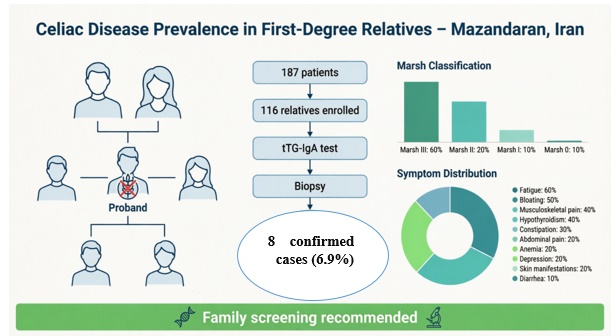
Materials and methods: This cross-sectional study investigated the prevalence of celiac disease among first-degree relatives of patients with celiac disease in Mazandaran Province, Iran. Among 187 registered patients, 116 first-degree relatives participated in the screening program. The mean age of participants was 42 years, and 80% were female. Serum anti-tissue transglutaminase immunoglobulin A (tTG-IgA) levels were measured as part of the screening process. Individuals with positive or borderline results underwent upper gastrointestinal endoscopy and duodenal biopsy. Duodenal biopsy specimens were evaluated according to the Marsh classification.
Results: Positive tTG-IgA serology was detected in 10 participants (8.6%). Celiac disease was confirmed by duodenal biopsy in eight participants (6.9%), including two with Marsh II and six with Marsh III histological changes. Among participants with positive tTG-IgA, five were mothers, three were sisters, one was a father, and one was a brother of patients with celiac disease. The most frequently reported manifestations were fatigue, abdominal bloating, musculoskeletal complaints, and hypothyroidism. One participant with biopsy-confirmed celiac disease was completely asymptomatic.
Conclusion: The prevalence of biopsy-confirmed celiac disease among first-degree relatives in Mazandaran Province was considerably higher than that reported for the general Iranian population. First-degree relatives may have an increased risk of celiac disease, even in the absence of symptoms. Early diagnosis may help reduce disease-related complications. However, the cross-sectional design and small sample size do not support definitive recommendations for routine screening. Further prospective studies are needed to evaluate targeted screening strategies in this high-risk population.
Materials and methods: This cross-sectional study investigated the prevalence of celiac disease among first-degree relatives of patients with celiac disease in Mazandaran Province, Iran. Among 187 registered patients, 116 first-degree relatives participated in the screening program. The mean age of participants was 42 years, and 80% were female. Serum anti-tissue transglutaminase immunoglobulin A (tTG-IgA) levels were measured as part of the screening process. Individuals with positive or borderline results underwent upper gastrointestinal endoscopy and duodenal biopsy. Duodenal biopsy specimens were evaluated according to the Marsh classification.
Results: Positive tTG-IgA serology was detected in 10 participants (8.6%). Celiac disease was confirmed by duodenal biopsy in eight participants (6.9%), including two with Marsh II and six with Marsh III histological changes. Among participants with positive tTG-IgA, five were mothers, three were sisters, one was a father, and one was a brother of patients with celiac disease. The most frequently reported manifestations were fatigue, abdominal bloating, musculoskeletal complaints, and hypothyroidism. One participant with biopsy-confirmed celiac disease was completely asymptomatic.
Conclusion: The prevalence of biopsy-confirmed celiac disease among first-degree relatives in Mazandaran Province was considerably higher than that reported for the general Iranian population. First-degree relatives may have an increased risk of celiac disease, even in the absence of symptoms. Early diagnosis may help reduce disease-related complications. However, the cross-sectional design and small sample size do not support definitive recommendations for routine screening. Further prospective studies are needed to evaluate targeted screening strategies in this high-risk population.
Keywords: celiac disease, first-degree relatives, anti-tissue transglutaminase antibody, tTG-IgA, duodenal biopsy
Type of Study: Research(Original) |
Subject:
Gastroenterology and Hepatology
Send email to the article author
| Rights and permissions | |
 |
This work is licensed under a Creative Commons Attribution-NonCommercial 4.0 International License. |

Articles Copyright © The Author(s). Owned by Mazandaran University of Medical Sciences.
Contact Us
Address: Journal Office, Building No. 2, Mazandaran University of Medical Sciences, Moallem Square, Sari.Tel: +98 (011)34484874 Postal code: 48175-866 E-Mail: jmums@mazums.ac.ir Telefax: +98 (011)33262679
