

Volume 36, Issue 261 (10-2026)
J Mazandaran Univ Med Sci 2026, 36(261): 247-259 |
Back to browse issues page



Download citation:
BibTeX | RIS | EndNote | Medlars | ProCite | Reference Manager | RefWorks
Send citation to:


BibTeX | RIS | EndNote | Medlars | ProCite | Reference Manager | RefWorks
Send citation to:
Khanaghaii M, Khoshnazar Z, Mohammadi-Sarab S, Hashemi Dezzaki F, Hosseini Koukamari P. Attitudes Towards Older Adults and Aging in Iran: A Scoping Review. J Mazandaran Univ Med Sci 2026; 36 (261) :247-259
URL: http://jmums.mazums.ac.ir/article-1-23161-en.html
URL: http://jmums.mazums.ac.ir/article-1-23161-en.html
Mobina Khanaghaii 
 , Zahedeh Khoshnazar , Soma Mohammadi-Sarab , Fatemeh Hashemi Dezzaki , Parisa Hosseini Koukamari
, Zahedeh Khoshnazar , Soma Mohammadi-Sarab , Fatemeh Hashemi Dezzaki , Parisa Hosseini Koukamari
Abstract: (17 Views)
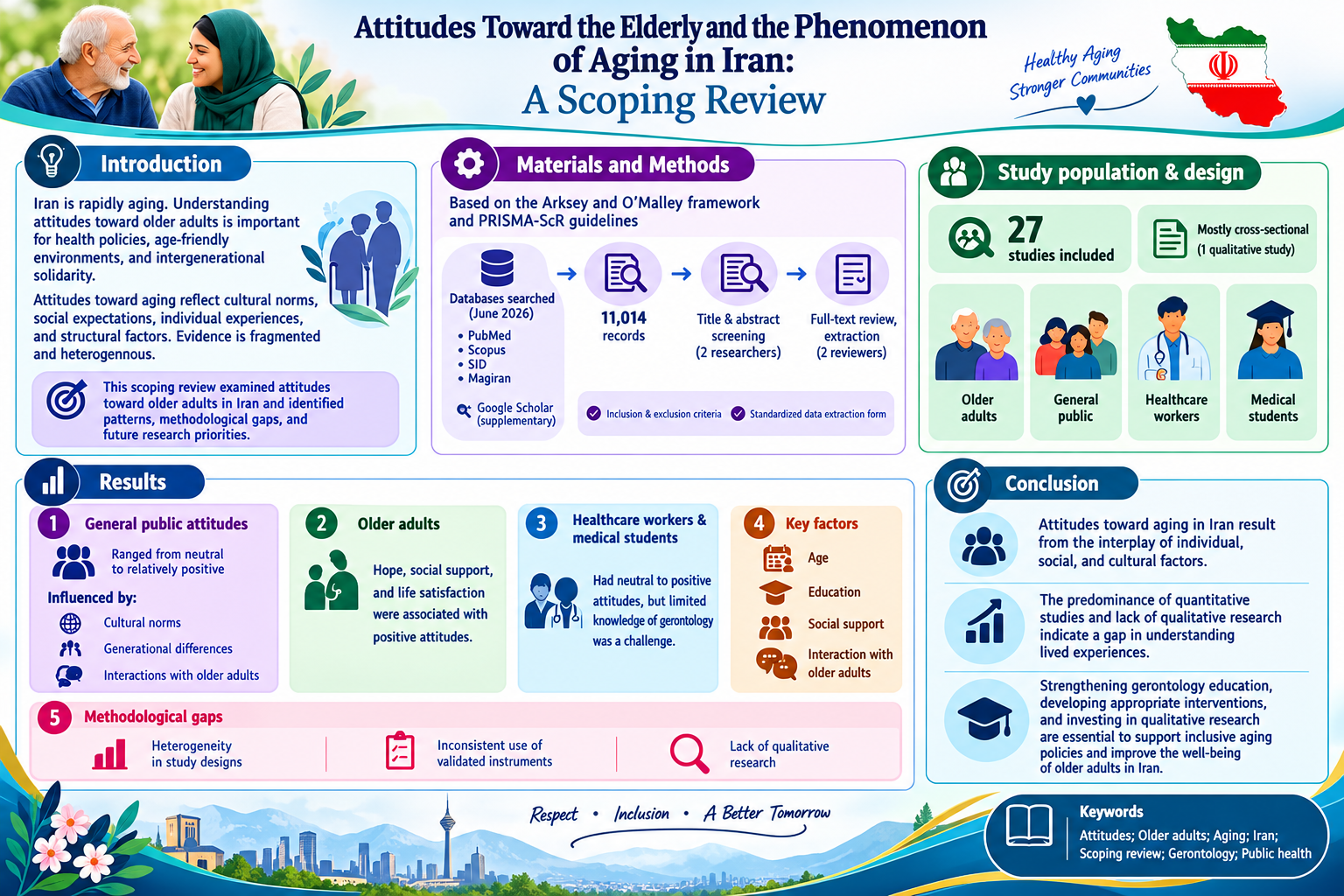
Background and purpose: Iran is rapidly aging. Understanding attitudes toward older adults is important for health policies, age-friendly environments, and intergenerational solidarity. Attitudes toward aging reflect cultural norms, social expectations, individual experiences, and structural factors. Evidence on these attitudes is fragmented and heterogeneous. This scoping review examined attitudes toward older adults in Iran and identified patterns, methodological gaps, and priorities for future research.
Materials and methods: This scoping review was conducted in accordance with the Arksey and O’Malley framework and PRISMA-ScR guidelines. A literature search was conducted in June 2026 in PubMed, Scopus, SID, and Magiran without restrictions on publication date or language. A Google Scholar search was conducted as a supplement. Two researchers screened titles, abstracts, and full texts. Studies were selected based on predefined inclusion and exclusion criteria, and data were extracted by two reviewers using a standardized form.
Results: Of 11,014 records, 27 studies were included. Most studies were cross-sectional, and one was qualitative. Study populations included older adults, the general public, healthcare workers, and medical students. General public attitudes ranged from neutral to relatively positive and were influenced by cultural norms, generational differences, and interactions with older adults. Among older adults, hope, social support, and life satisfaction were associated with positive attitudes. Healthcare workers and medical students had neutral to positive attitudes; however, limited knowledge of gerontology was identified as a challenge. Age, education, social support, and interaction with older adults were key factors. Methodological heterogeneity, inconsistent use of validated instruments, and a lack of qualitative research were evident.
Conclusion: Attitudes toward aging in Iran are shaped by the interplay of individual, social, and cultural factors. The predominance of quantitative studies and lack of qualitative research highlight a gap in understanding the lived experiences of older adults. Strengthening gerontology education, developing appropriate interventions, and investing in qualitative research are essential to support inclusive aging policies and improve the well-being of older adults in Iran.
Materials and methods: This scoping review was conducted in accordance with the Arksey and O’Malley framework and PRISMA-ScR guidelines. A literature search was conducted in June 2026 in PubMed, Scopus, SID, and Magiran without restrictions on publication date or language. A Google Scholar search was conducted as a supplement. Two researchers screened titles, abstracts, and full texts. Studies were selected based on predefined inclusion and exclusion criteria, and data were extracted by two reviewers using a standardized form.
Results: Of 11,014 records, 27 studies were included. Most studies were cross-sectional, and one was qualitative. Study populations included older adults, the general public, healthcare workers, and medical students. General public attitudes ranged from neutral to relatively positive and were influenced by cultural norms, generational differences, and interactions with older adults. Among older adults, hope, social support, and life satisfaction were associated with positive attitudes. Healthcare workers and medical students had neutral to positive attitudes; however, limited knowledge of gerontology was identified as a challenge. Age, education, social support, and interaction with older adults were key factors. Methodological heterogeneity, inconsistent use of validated instruments, and a lack of qualitative research were evident.
Conclusion: Attitudes toward aging in Iran are shaped by the interplay of individual, social, and cultural factors. The predominance of quantitative studies and lack of qualitative research highlight a gap in understanding the lived experiences of older adults. Strengthening gerontology education, developing appropriate interventions, and investing in qualitative research are essential to support inclusive aging policies and improve the well-being of older adults in Iran.
Send email to the article author
| Rights and permissions | |
 |
This work is licensed under a Creative Commons Attribution-NonCommercial 4.0 International License. |

Articles Copyright © The Author(s). Owned by Mazandaran University of Medical Sciences.
Contact Us
Address: Journal Office, Building No. 2, Mazandaran University of Medical Sciences, Moallem Square, Sari.Tel: +98 (011)34484874 Postal code: 48175-866 E-Mail: jmums@mazums.ac.ir Telefax: +98 (011)33262679
